About Venerupis corrugata (Gmelin, 1791)
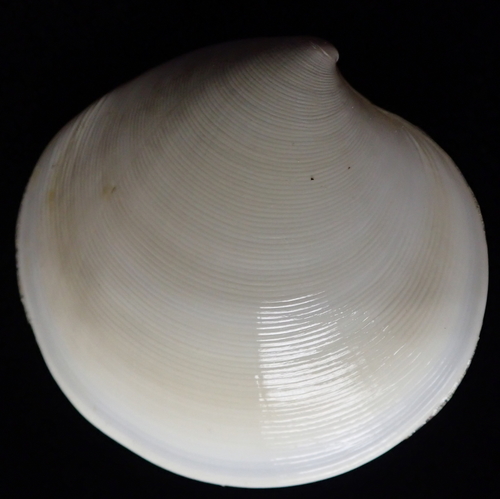
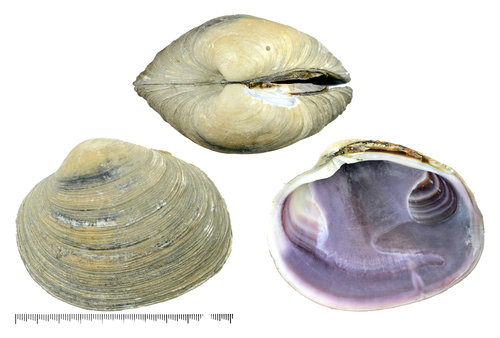
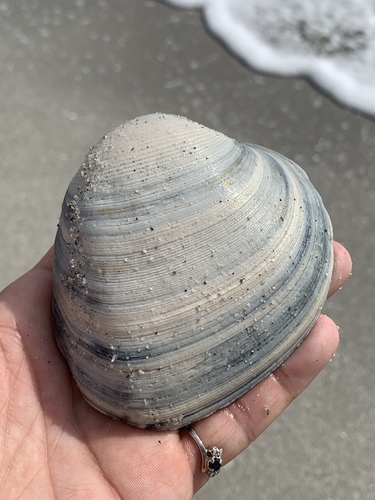
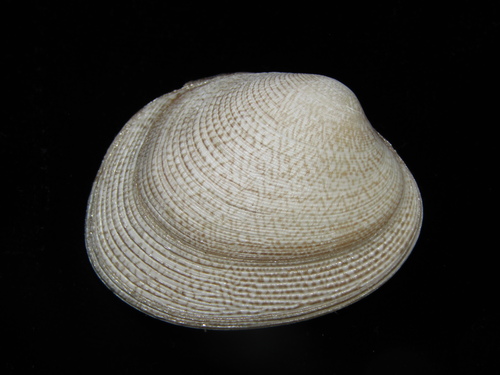
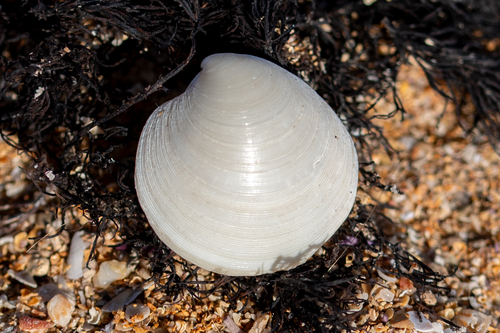
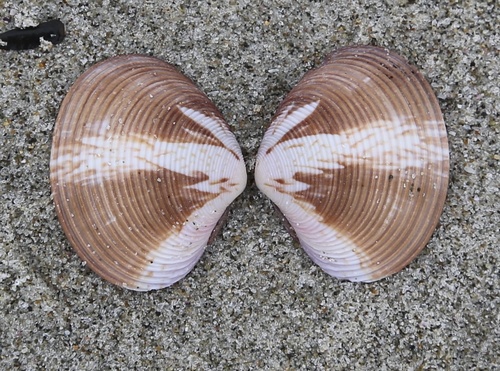
Venerupis corrugata, commonly called the pullet carpet shell, has a pair of hinged, oblong valves that reach approximately 5 centimetres (2.0 inches) in length. The umbone, or beak, is positioned roughly one third of the way along the length of the shell. The anterior section of the hinge forms an angle with the posterior section, and each valve bears 3 cardinal teeth. The outer surface of the shell is sculpted with fine radial ribs that run from the umbone to the shell margin, alongside fine concentric striations. The shell’s exterior colour is cream, grey, or pale brown, sometimes marked with irregular darker streaks or rays. The inner surface of the shell is glossy white, sometimes with purple markings near the umbone. The adductor muscle scars and pallial line are clearly visible, and there is a large, rounded pallial sinus. This species has siphons that are joined along their entire length, a trait that separates it from the otherwise similar species Ruditapes decussatus. This species occurs in shallow waters of the East Atlantic and the Mediterranean Sea, with its range extending from the coasts of Norway south to West Africa. It burrows shallowly just below the surface of sand, mud, or gravel, and can be found from the intertidal zone down to a depth of about 40 metres (130 feet).