About Velella velella (Linnaeus, 1758)
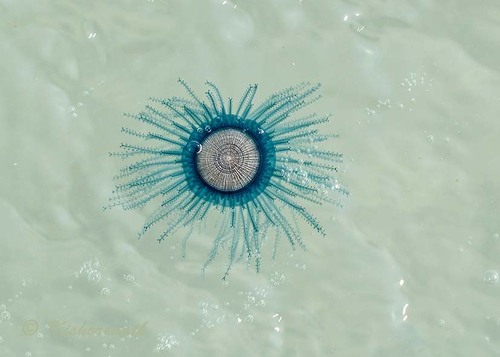
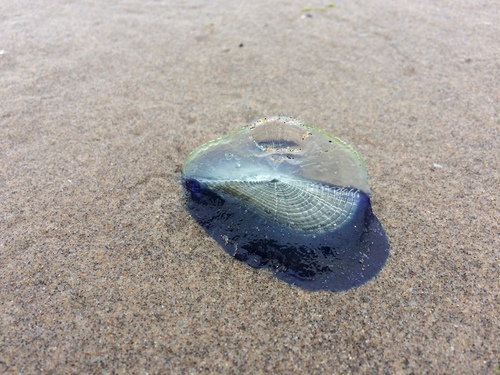
Velella is a monospecific genus of hydrozoa in the family Porpitidae. Its only known species is Velella velella (Linnaeus, 1758), a cosmopolitan, widely distributed free-floating hydrozoan that lives on the surface of the open ocean. It is commonly known by the names sea raft, by-the-wind sailor, purple sail, little sail, or simply Velella. This small cnidarian belongs to a specialized ocean surface community that also includes the better-known cnidarian siphonophore, the Portuguese man o' war. Specialized predatory gastropod molluscs prey on these cnidarians, including nudibranchs (sea slugs) in the genus Glaucus and purple snails in the genus Janthina. Each visible Velella velella is not a single individual, but a hydroid colony. Most colonies are less than about 7 cm (2.8 in) long. They are typically deep blue in color, and their most noticeable feature is a small stiff sail that catches wind to propel them across the sea surface. Under certain wind conditions, thousands of these organisms can become stranded on beaches. Like other cnidarians, V. velella are carnivorous. They catch prey, generally plankton, using tentacles that hang down into the water and bear nematocysts, which are also called cnidocysts. The toxins in these nematocysts work effectively against their prey. While all cnidarians have nematocysts, some species have far more powerful nematocysts and toxins than others. V. velella's nematocysts are relatively harmless to humans, though individual people may have different reactions after contact with the toxin. It is recommended to avoid touching your face or eyes after handling V. velella, and itching can develop on skin exposed to V. velella nematocysts. V. velella lives in warm and temperate waters across all the world's oceans. They occupy the water-air interface, with their float positioned above water, and polyps hanging roughly one centimetre below the surface. Organisms that live partially in and partially out of water like this are classified as neuston. Offshore boaters sometimes encounter thousands of V. velella gathered on the water surface. The small rigid sail projects into the air to catch wind. V. velella sails always align along the direction of the wind, where the sail can act as an aerofoil. This causes the organisms to sail downwind at a slight angle to the wind direction. With no form of locomotion other than its sail, V. velella moves entirely at the mercy of prevailing winds. This makes them prone to large mass strandings on beaches around the world. For example, a mass stranding happens most years in spring along the West Coast of North America, ranging from British Columbia to California. Strandings begin in the north and shift south over several weeks. In some years, so many individuals are left at the tide line by receding waves that the layer of dying, and later rotting, animals can be many centimetres deep along hundreds of kilometres of beaches. Mass strandings have also been recorded on the west coast of Ireland, and in Hayle on the west coast of Cornwall in England. Like many hydrozoans, V. velella has a two-part life cycle with a form of alternation of generations. The conspicuous deep blue by-the-wind sailors that beach visitors recognize are the polyp phase of the life cycle. Each so-called individual with a sail is actually a hydroid colony connected by a canal system, which allows the colony to share food ingested by individual polyps. Each by-the-wind sailor colony is made up entirely of either all-male or all-female polyps. The colony hosts several different types of polyps: gonozooids, which handle both feeding and reproduction, and dactylozooids, which serve a protective function. Each gonozooid produces numerous tiny jellyfish through asexual budding. Over several weeks, a single V. velella colony can produce thousands of tiny jellyfish called medusae, each about 1 mm (0.039 in) high and wide. Each tiny medusa carries many zooxanthellae, single-celled endosymbiotic organisms also commonly found in corals and some sea anemones. These zooxanthellae use sunlight to produce energy for the jellyfish. Notably, while healthy captive V. velella will release many medusae that can be observed under a microscope, and they are expected to do the same in the open ocean, V. velella medusae are rarely captured in plankton samples, and very little is known about their natural history. In laboratory conditions, medusae develop to sexual maturity in approximately three weeks. Their freely spawned eggs and sperm develop into a planktonic larva called a conaria, which then grows into a new floating V. velella hydroid colony.