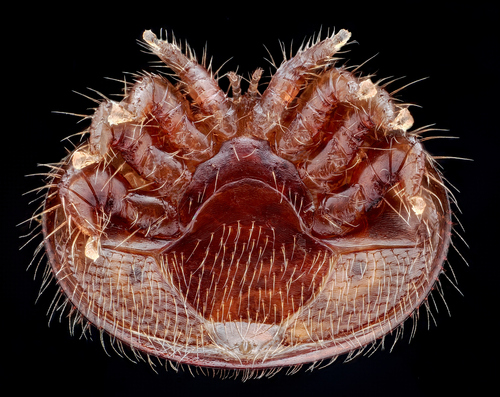
About Varroa destructor Anderson & Trueman, 2000
In description and taxonomy, the adult female Varroa destructor mite is reddish-brown, while the adult male is white. These mites are flat, button-shaped, 1–1.8 mm long and 1.5–2 mm wide, with eight legs. They have no eyes, and their curved bodies let them fit between the abdominal segments of adult bees. Host bee species help distinguish between different mite species in the Varroa genus. Both V. destructor and Varroa jacobsoni parasitize Apis cerana, the Asian honey bee, but the closely related V. jacobsoni, originally described by Anthonie Cornelis Oudemans in 1904, does not attack Apis mellifera, the western honey bee, unlike V. destructor. Until 2000, V. destructor was incorrectly classified as V. jacobsoni, leading to mislabeling in scientific literature. The two species cannot be easily distinguished by physical traits, and their genomes are 99.7% similar, so DNA analysis is required to tell them apart. Because the more virulent, more damaging V. destructor could not be distinguished from V. jacobsoni before 2000, most pre-2000 research on western honey bees that references V. jacobsoni actually studied V. destructor. Two other Varroa species, V. underwoodi and V. rindereri, can also parasitize honey bee species. They can be told apart from V. destructor and V. jacobsoni by slight differences in body size and setae characteristics, though all four species in the Varroa genus share similar overall physical traits. If a Varroa species is found on a western honey bee, it is typically V. destructor except in regions where V. underwoodi occurs, such as Papua New Guinea. After V. destructor was recognized as a separate species from V. jacobsoni, the common name "Varroa mite" has generally been used to refer to V. destructor. Varroa destructor has two distinct genetic strains that formed when it switched hosts from the Asian honey bee to the western honey bee: the Korean strain and the Japanese strain. The Korean strain emerged in 1952 and is now found worldwide at high frequencies, while the Japanese strain emerged around 1957, occurs in the same general regions, and is found at much lower frequencies. Varroa destructor has low genetic diversity, which is typical for invasive species undergoing range or host expansion. For range, Varroa destructor originally occurred only in Asia on the Asian honey bee, but the species has since been introduced to many other countries across several continents, causing disastrous infestations of European honey bees. Introduction records before 2000 are unclear, due to prior confusion between V. destructor and V. jacobsoni. By 2020, V. destructor was confirmed to be present throughout North America (excluding Greenland), South America, most of Europe and Asia, and portions of Africa. It was not confirmed present in Australia, Oman, the Republic of Congo, the Democratic Republic of the Congo, and Malawi. It was suspected to be absent from Sudan and Somalia. Mites were detected in New South Wales, Australia in 2022. In its life cycle, female mites enter bee brood cells to lay eggs on the comb wall after the cell is capped. Eggs are approximately 0.2 to 0.3 mm in diameter and cannot be seen without magnification. Eggs hatch into male and female protonymphs, which are both transparent white. Immature mites can only feed on capped brood, so their life cycle cannot be completed during broodless periods. Protonymphs molt into deuteronymphs, which have the curved body shape more similar to adults, before molting into their adult form. The total development time from egg to adult is 6–7 days. Males never leave the brood cell, and only mate with females that are present inside the brood cell. Adult females can feed on both brood and adult bees. After reaching adulthood, females leave the brood cell and enter a phoretic stage, where they attach to adult bees to disperse. Mites feed on adult bees during this stage, and can be transmitted between bees here. Nurse bees are the preferred phoretic hosts, as this allows mites to be carried to new brood cells. Because nurse bees spend more time near drone brood (male bee brood) than worker brood, many more drones become infected with mites. Phoretic females can also transmit to other hives through direct bee contact or through the transfer of hive equipment. The phoretic stage lasts 4.5–11 days during periods of brood production, and can last up to five to six months when no brood is present during winter. When brood is present, female mites have a life expectancy of 27 days. After the phoretic stage, female mites leave the adult bee and enter brood cells containing bee larvae. They prefer drone brood cells over worker brood cells. These entering females are called foundress mites. They bury themselves in the brood food provided by worker bees before the brood cell is capped. When the cell is capped, it triggers egg activation in the foundress mite, and she emerges to feed on the bee larva. After feeding, she lays a single unfertilized egg, which develops into a male mite. After laying this first egg, she lays one fertilized egg that develops into a female mite approximately once per day. Both the mother mite and the hatching nymphs feed on the developing bee pupa. Unless multiple foundress mites share the same cell, mating occurs between sibling mites after they reach adulthood. Once a female mates, she cannot receive additional sperm. Varroa destructor’s genetic bottleneck is likely caused by its habit of sibling mating.

