About Variola louti (Forsskål, 1775)
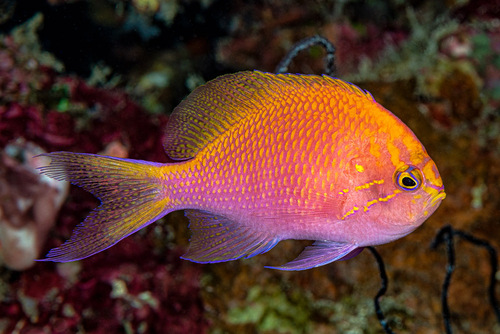
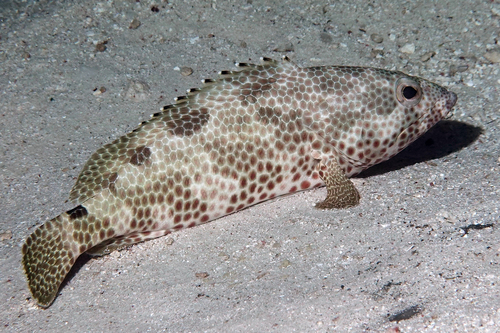
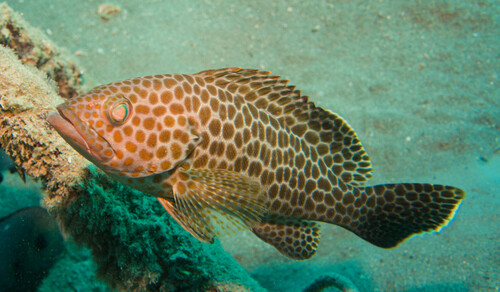
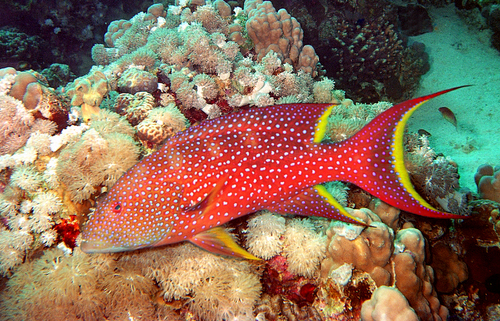
This species, commonly called the yellow-edged lyretail, is a grouper with an oblong body. Its head is longer than the body is deep, and its standard body length measures 2.8 to 3.3 times its body depth. The preopercle is rounded, with fine serrations along its edge and a fleshy lower edge. Three flat spines sit on the gill cover, which has a straight upper edge. The dorsal fin holds 9 spines and 13 to 14 soft rays, while the anal fin holds 3 spines and 8 soft rays. The caudal fin is crescent-shaped, with extended upper and lower lobes that are roughly twice the length of the fin’s middle rays. The dorsal and anal fins have pointed posterior tips. The overall body colour is reddish, and the upper body is typically reddish that frequently shades to orangish or white on the lower body. The entire head, body and fins are covered in many small bluish or pinkish spots, and the rear margins of the fins are yellow. Juvenile yellow-edged lyretails appear to mimic goatfishes from the family Mullidae. This species reaches a maximum recorded total length of 83 centimetres (33 in), with 75 centimetres (30 in) being a more common adult length, and a maximum recorded weight of 12 kilograms (26 lb). The yellow-edged lyretail has an Indo-Pacific distribution. Its range extends along the east coast of Africa from Durban, South Africa to the Red Sea, east through the tropical Indian Ocean into the Pacific Ocean, reaching as far north as southern Japan, as far south as Australia, and as far east as the Pitcairn Islands. In Australia, it can be found from Shark Bay in Western Australia to Ashmore Reef in the Timor Sea; from Cape York in Queensland south to Sydney in New South Wales; at Frederick Reefs and Coringa-Herald National Nature Reserve in the Coral Sea; and at Middleton and Elizabeth Reefs and Lord Howe Island in the Tasman Sea. It has been recorded twice in the eastern Mediterranean Sea off Cyprus, once in 2018 and once in 2019; these occurrences are thought to stem from either aquarium release or introduction from the Red Sea through the Suez Canal. The yellow-edged lyretail is typically found in clear water at depths between 15 metres (49 ft) and 350 metres (1,150 ft), and it prefers habitats around islands and offshore reefs rather than continental shores. It feeds mainly on fishes, and also eats crabs, shrimps, and stomatopods. Females reach sexual maturity at a standard length of 33 centimetres (13 in). Spawning aggregations of this species have been recorded off Aceh, Sumatra. It has not yet been confirmed that this species is a protogynous hermaphrodite. Spawning occurs between December and February.