About Variola albimarginata Baissac, 1953
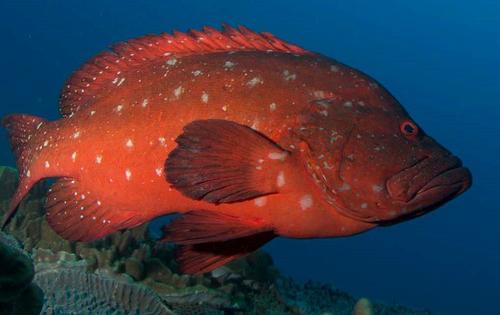
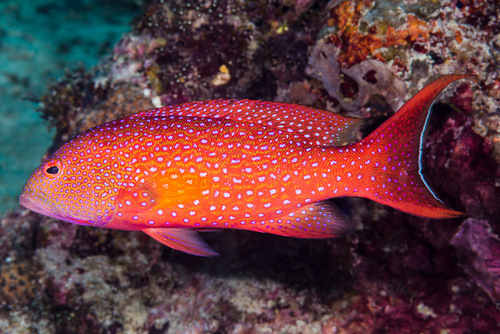
The white-edged lyretail (Variola albimarginata Baissac, 1953) has an oblong body, where head length is greater than body depth, and standard body length measures 2.8 to 3.5 times body depth. The preopercle is rounded, with fine serrations along its edge and a fleshy lower edge. Three flat spines sit on the gill cover, which has a straight upper edge. The dorsal fin has 9 spines and 14 soft rays, while the anal fin has 3 spines and 8 soft rays. The caudal fin is crescent-shaped, with extended upper and lower lobes that are roughly twice as long as the fin's middle rays. This grouper has an overall reddish body covered in blue spots. The caudal fin has pale upper and lower margins, and the central caudal fin rays have white tips that form a thin white line along the fin's margin. Occasionally, faint pale saddles appear on the back, and the fish also has yellow wavy lines on its body and reddish spots on its head. The dorsal, anal, and caudal fins bear red to purple spots. The maximum recorded total length for this species is 65 centimetres (26 in).
The white-edged lyretail has a wide distribution across the Indo-Pacific region. Its range extends along the East African coast between Kenya and Mozambique, including Zanzibar and Mafia Island, across the Indian Ocean to the Seychelles, southwestern India, and Sri Lanka, and into the Pacific Ocean, reaching north to the Ryukyu Islands of southern Japan, east to Samoa and the Cook Islands, and south to Australia. In Australia, it occurs from Scott Reef in Western Australia and Ashmore Reef in the Timor Sea to the Capricorn Group in the southern Great Barrier Reef of Queensland.
The white-edged lyretail is a generally uncommon species. It occurs either solitarily or in small groups on the seaward edge of reefs. Juveniles are found in inshore areas on algae and soft coral reefs, where they typically swim quite high in the water column, similar to basslets. This species is largely piscivorous (feeding primarily on fish). It is not known to form spawning aggregations. Females reach sexual maturity at a standard length of 32 centimetres (13 in).