About Varanus rosenbergi Mertens, 1957
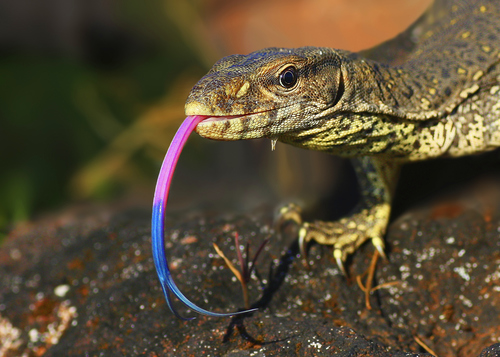
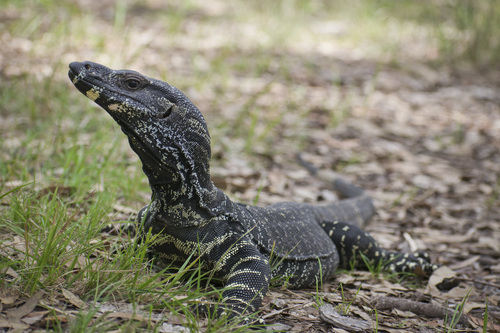
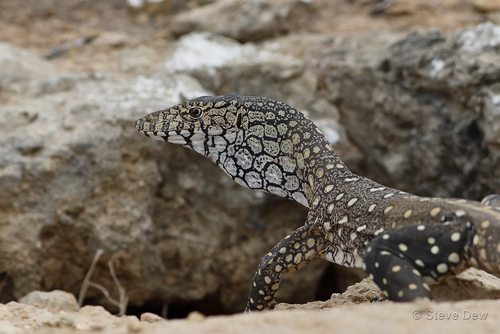
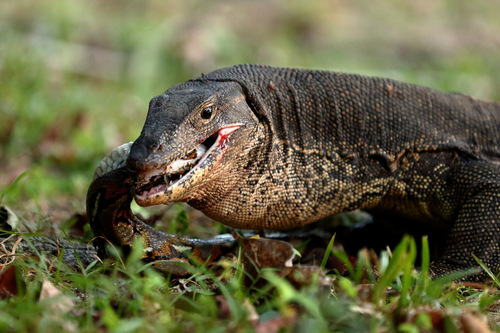
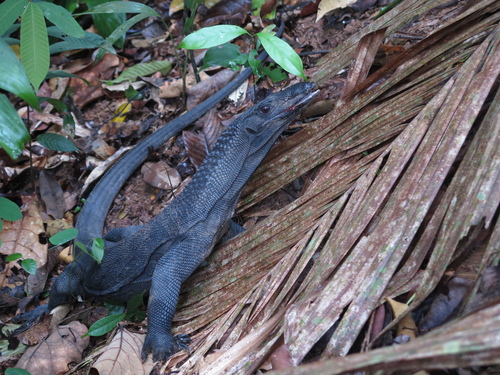
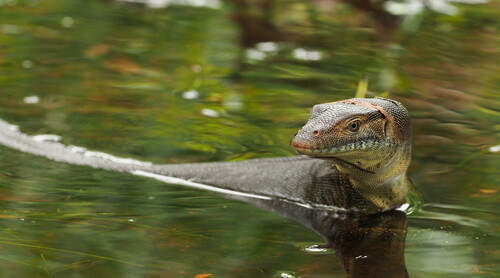
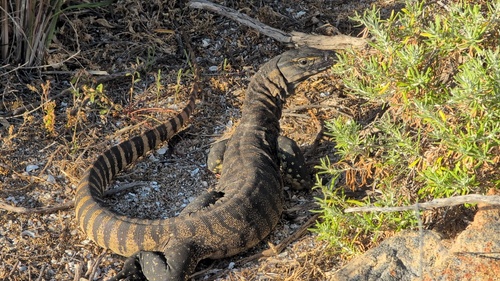
Varanus rosenbergi, commonly known as Rosenberg's monitor or heath monitor, is a species of monitor lizard. Like most other monitor lizards, it is a fast-moving predator with a long tail, stout limbs, and clawed feet. It closely resembles the closely related, widespread sand goanna (Varanus gouldii), and was previously classified as a subspecies of V. gouldii. It can be distinguished from V. gouldii by its overall darker coloration, particularly in the markings on the tail tip and underside, and distinct black banding across the back and neck. Dull, poorly defined yellow stripes run along most of the tail's length, sometimes breaking up the blackish coloration at the tail's end. The feet and limbs are also very dark, spotted with creamy or brownish coloring. The dark-toned head has yellow dots above the mouth, and the yellowish cream background of the underside displays a blackish reticular pattern. The largest specimens occur on Kangaroo Island, located off the coast of South Australia; Kangaroo Island individuals are also darker than mainland specimens and have a greater number of scale rows on the ventral side. Fat layers in Rosenberg's monitor make up approximately 7.6% of an individual's body weight, allowing energy reserves to be stored throughout the body and tail. This species can reach a total length of 1.5 metres. It has a dark gray base color with yellow and white spotting and black bands that run across the body and all the way down the tail. Juvenile individuals have an orange tinge. Unlike the related subgenus Odatria, where sex differences in the ratio of head length to body length are often obvious, this difference is not easily discernible in V. rosenbergi, a member of the subgenus Varanus. This species is distributed across southern Australia, with all recorded occurrences falling south of the 30°S line of latitude. In Southwest Australia, its range extends south of Mussel Pool (northeast of the state capital Perth) and inland from the southern coast, reaching close to Bendering, Norseman, and Balladonia, before extending east to Eucla and into South Australia. Rosenberg's monitor is most common in the western part of its range, and is locally abundant in favourable habitat; its range is deeply fragmented in the east. Isolated populations near Canberra and Sydney may represent a separate species. A subpopulation of larger-bodied individuals occurs on Kangaroo Island, while the mainland South Australian population is considered rare. Records of the species also confirm its occurrence in the eastern Australian states of New South Wales, the Australian Capital Territory, and Victoria. This monitor occurs from near sea level up to elevations of less than 1500 metres above sea level. The isolated population in New South Wales, which is suspected to be a sister species, occurs across a range of elevations, including sites above the snow line in eastern Australia's mountain regions. Individual Rosenberg's monitors have comparatively large home ranges. The species' distribution overlaps with the sand goanna (Varanus gouldii), and the two species are sometimes sympatric, particularly in southern areas of the Western Australian wheatbelt and on the Swan Coastal Plain; the two species do not hybridize. Historical taxonomic uncertainty led to the widespread V. gouldii being incorrectly recorded as occurring in the southern coastal areas that V. rosenbergi occupies, and the known range of V. gouldii was later revised to exclude these areas. Females expend a large amount of energy producing and defending eggs, so they typically take a 1 to 2 year break between clutches, though this is not always the case. Males, by contrast, usually mate every year. Reproductive behaviour, including nest site guarding, takes place during summer over a four-month period each year for sexually active adults, starting before the December solstice and ending after the March equinox. Rosenberg's monitor is most often associated with sandy heathland, open woodland, or sclerophyll forest plant communities as its preferred habitat, though the species has been recorded in other vegetation types. The near-coastal areas it inhabits are frequently saline environments. Subalpine environments in the southernmost parts of its range, such as the Naas Valley in the Australian Capital Territory, sometimes experience snowfall where this species occurs. Rosenberg's monitors excavate burrows for shelter, or use rock fissures and hollow trees.