About Varanus prasinus (Schlegel, 1839)
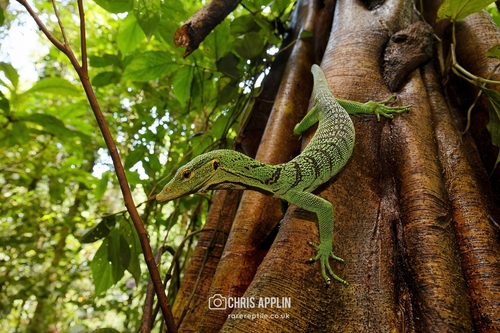
The emerald tree monitor, also called the green tree monitor, has a total length of 75–100 cm (30–39 in), with a slender body that lets it move and support itself on narrow branches. It uses its prehensile tail and long claws to grip onto branches. Unlike other varanids, this species defends its tail instead of lashing with it when it feels threatened. The soles of its feet have enlarged scales that help it climb more effectively.
Emerald tree monitors and their close relatives live on the island of New Guinea, which is split between Indonesia and Papua New Guinea, as well as on several adjacent islands and the northern Torres Strait Islands. The green tree monitor is recorded to thrive in lowland environments, including tropical evergreen forests, palm swamps, and cocoa plantations.
When threatened, the emerald tree monitor will flee through vegetation, or bite if it is cornered. It is one of the few social monitor lizard species, living in small groups that consist of one dominant male, several females, and a small number of other males and juveniles.
Female emerald tree monitors lay clutches of up to five eggs. Each egg weighs 10.5–11.5 g (0.37–0.41 oz) and measures approximately 2 by 4.5 cm (0.79 by 1.77 in). Females can lay as many as three clutches over the course of a year; captive individuals have been recorded laying clutches in January, March, April, November, and December. The female lays her eggs in arboreal termite nests. The eggs hatch between 160 and 190 days after being laid, most often between June and November. Within minutes of hatching, the young lizards eat the termites and termite eggs around them. Individuals reach sexual maturity at around one year of age.