About Varanus niloticus (Linnaeus, 1766)
The Nile monitor (scientific name Varanus niloticus (Linnaeus, 1766)) is Africa's longest lizard. Adults range from roughly 120 to 220 cm (3 ft 11 in to 7 ft 3 in) in total length, and the largest recorded specimens reach 244 cm (8 ft). For an average-sized adult, the snout-to-vent length is approximately 50 cm (1 ft 8 in). Reported adult body masses vary widely: one study recorded a range of only 0.8 to 1.7 kg (1.8 to 3.7 lb), while other sources note that large Nile monitors weigh 5.9 to 15 kg (13 to 33 lb). This variation may be caused by differences in age or environmental conditions. Exceptionally large specimens can weigh up to 20 kg (44 lb), but on average, this species is lighter than the bulkier rock monitor.
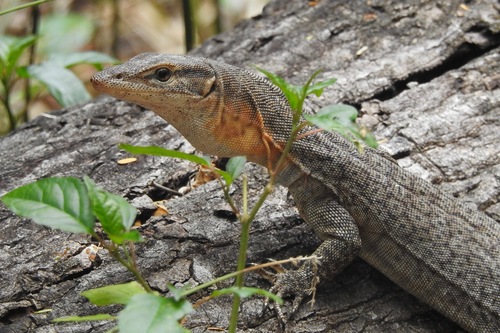
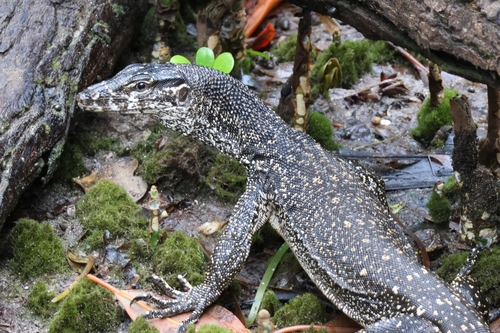
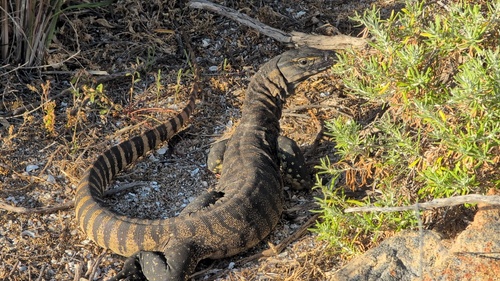
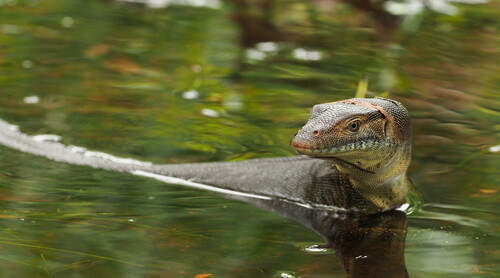
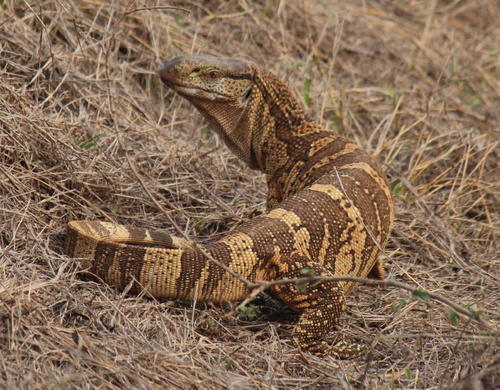
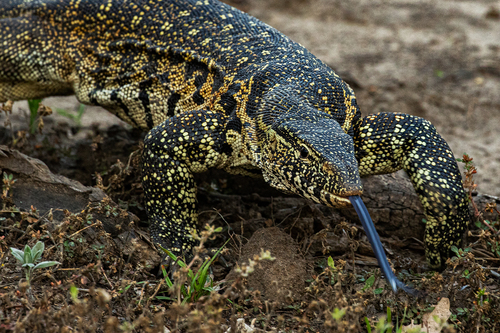
Nile monitors have muscular bodies, strong legs, and powerful jaws. Juveniles have sharp, pointed teeth, which become blunt and peg-like as they mature. They also have sharp claws that they use for climbing, digging, defense, and tearing prey. Like all monitor lizards, they have forked tongues with a highly developed sense of smell. Their skin patterns are striking but variable: the upper body is greyish-brown, the tail has greenish-yellow barring, and the back bears large greenish-yellow rosette-shaped spots with a small black spot at the center. The throat and underside range from ochre-yellow to creamy-yellow, and often have faint barring. Their nostrils are positioned high on the snout, a trait that reflects their strong adaptation to an aquatic lifestyle. Nile monitors are also excellent climbers and fast runners on land.
Nile monitors eat a very wide range of prey. This includes fish, frogs and toads (even the poisonous species belonging to the genera Breviceps and Sclerophrys), small reptiles such as turtles, snakes, other lizards, and young crocodiles, birds, rodents, other small mammals up to the size of domestic cats and young Raphicerus antelopes, and eggs from crocodiles, agamid lizards, other monitor lizards, and birds. Their diet also includes invertebrates such as beetles, termites, orthopterans, crabs, caterpillars, spiders, millipedes, earthworms, snails, and slugs, plus carrion, human wastes, and feces.
Nile monitors are native to Sub-Saharan Africa and along the Nile. They do not live in Africa's desert regions, most notably the Sahara, the Kalahari, and most of the Horn of Africa, and they thrive in habitats around rivers. They were recorded living in and around the Jordan River, the Dead Sea, and wadis of Israel's Judaean Desert until the late 19th century, but the species is now extinct in that region.