About Varanus exanthematicus (Bosc, 1792)
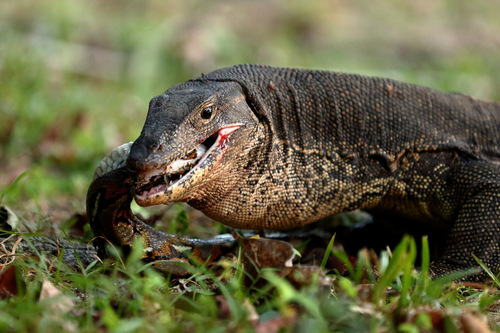
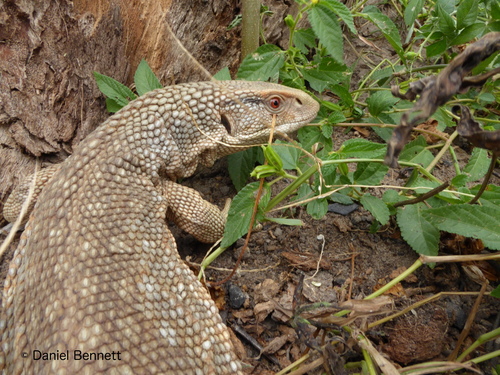
Savannah monitors (scientific name Varanus exanthematicus (Bosc, 1792)) are stoutly built lizards with relatively short limbs and toes. Their skulls and dentition are adapted to feed on hard-shelled prey; they are robust creatures with powerful digging limbs, strong jaws, and blunt, peglike teeth. Teeth are replaced approximately every 109 days. This species rarely reaches a maximum size of more than 100 cm. Its skin color pattern varies to match the substrate of its local habitat. Body scales are large, with usually fewer than 100 scales around the midsection. It has a partly laterally compressed tail with a double dorsal ridge, and nostrils that sit equidistant between the eyes and the tip of the snout. The savannah monitor is often confused with the white-throat monitor (Varanus albigularis), which can grow to 5–6 feet in length. While the two species are similar in overall appearance, they have significant morphological and ecological differences, and are recognized as separate distinct species. The range of Varanus exanthematicus extends across sub-Saharan Africa, from Senegal east to Sudan, and south almost to the Congo River and Rift Valley, where V. albigularis replaces this species. V. exanthematicus is primarily a ground-dwelling species that shelters in burrows, though it is sometimes found in bushes or low trees. In the coastal plain of Ghana, juvenile V. exanthematicus are often found associated with the burrows of the giant cricket Brachytrupes. For reproduction, females dig a deep hole in the substrate to lay up to 40 or more eggs. Eggs hatch after approximately 156–160 days. Hatchlings begin feeding a few days after their yolk sac is absorbed, a process that may take 12 days or more after hatching.