About Varanus acanthurus Boulenger, 1885
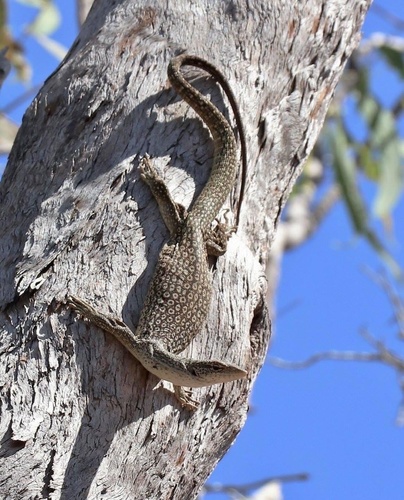
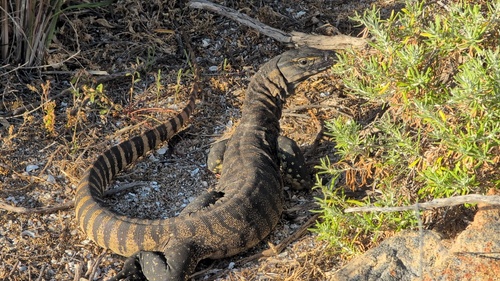
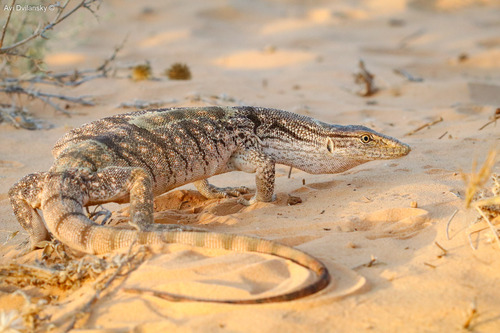
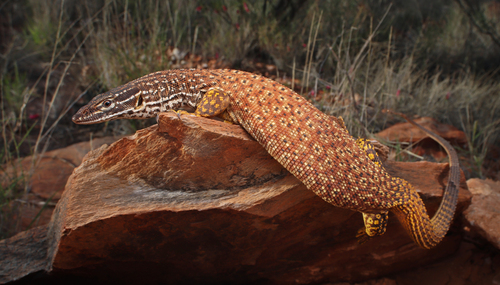
The spiny-tailed monitor (also called ackie monitor), a moderately small species of monitor lizard, reaches a maximum total length of 70 cm (27 in), though unconfirmed reports exist of wild individuals growing as long as 34 inches. Its tail is between 1.3 and 2.3 times as long as its head and body combined. The upper body is a rich dark brown, marked with bright yellowish to cream spots that often contain a few dark scales. The tail is round in cross-section and covered in very spiny scales. There are between 70 and 115 scales around the midsection of the body. This species can be told apart from similar-looking species V. baritji and V. primordius by the presence of pale longitudinal stripes on its neck. This arid-adapted lizard occurs in northern Western Australia, the Northern Territory, and the western and north-western regions of Queensland. It lives in association with arid rocky ranges and outcrops. The subspecies Varanus acanthurus acanthurus is native to northern Australia, ranging from Broome on the west coast, through the Kimberley and the Top End, to the Gulf of Carpentaria. Subspecies V. a. brachyurus is found in the center, western, and eastern parts of the species' full range, reaching as far west as Carnarvon and as far east as Mt. Isa. Subspecies V. a. insulanicus has a range restricted to Groote Eylandt and the Wessel Islands. Spiny-tailed monitors are diurnal, typically solitary ground-dwelling lizards. They are most often found in shelters, mainly under rock slabs, wedged between boulders, in rock crevices, or in burrows. They only rarely shelter in spinifex. Sheltering underground gives them access to humid microclimates, which helps them maintain enough hydration to survive the arid conditions of their habitat. Their diet matches that of intensive foragers, meaning they likely spend a considerable amount of time hunting. There are multiple methods to sex captive ackie monitors, and the hemipenal transillumination technique is generally considered the easiest and most accurate. Sex can also be estimated using visible physical traits, but this method is usually far less accurate. Male ackie monitors are typically larger, have blockier heads, and have grippy scales on the underside of the tail. Females are usually smaller, with narrower, pointier heads, and have smooth scales under the tail. In captivity, females lay clutches of up to 18 eggs. Hatchlings emerge after three to five months of incubation and measure 15 cm (6 in) in total length. Little information is available about reproduction in wild spiny-tailed monitors. Males most likely reach sexual maturity at a snout-vent length of 30 cm (12 in), while females mature at a snout-vent length of 25 to 36 cm (10 to 14 in). Ovulation occurs in August and November. Females lay their eggs in tunnels they dig themselves. In the wild, female spiny-tailed monitors have been observed sharing large burrows and nesting communally.