About Vanilla planifolia Andrews
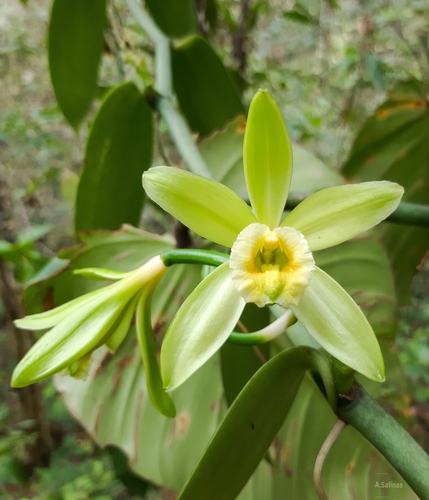
Vanilla planifolia Andrews is an evergreen vine that can grow along the ground, on trees, or occasionally as an epiphyte without rooting in soil. When rooted in soil, its terrestrial roots branch and develop fine root hairs that form associations with mycorrhizal fungi. In the wild, this vine commonly reaches 15 meters in length, and may grow as long as 30 meters. Vines growing in full shade rarely branch, while those exposed to sunlight develop multiple branches. Young, well-attached portions of the vine have a zig-zag structure, with a 120° angle at each node. To cling to trees and other surfaces, the vine produces thick, fleshy aerial roots from its nodes; these support roots almost never branch, and only form on young sections of the vine. Older sections of the vine hang down through the tree canopy to the forest floor. A single flat-bladed succulent leaf grows on nodes opposite the root nodes. Full-grown leaves are glossy bright green, 8–25 cm long and 2–8 cm wide, shaped from lanceolate to oval with a pointed tip. Undamaged leaves live for three to four years.
Vanilla planifolia is native to the neotropical realm, ranging from southern Mexico through Central America and Colombia to northern Brazil. Early sources previously considered it native only to southern Mexico and Belize. It has been spread through cultivation to tropical regions worldwide; in the Americas, this includes south Florida, the Cayman Islands, the Dominican Republic, Jamaica, Puerto Rico, and tropical parts of Peru, Ecuador, Venezuela, French Guiana, Suriname, and Guyana. Outside the Americas, it has spread to the Democratic Republic of the Congo, Madagascar, Comoros, Bangladesh, the Malay Peninsula, the island of Java, the Chagos Archipelago, the Cook Islands, New Guinea, and New Caledonia.
This species requires a humid, warm tropical climate, and grows best at temperatures between 20 and 30 °C (68 and 86 °F), with a minimum tolerable temperature of 10 °C (50 °F) and maximum of 33 °C (91 °F). It requires a minimum of 2000 mm of rainfall per year. For optimal growth, it prefers well-draining soil with a pH between 6.0 and 7.0, and abundant available calcium and potassium. Its natural native altitude range is 150 to 900 meters above sea level. A spring dry period is required to trigger flowering. Human land conversion for crops and timber has greatly reduced and fragmented suitable habitat for wild Vanilla planifolia, leading to declining numbers of mature individuals and ongoing loss of suitable habitat. The International Union for Conservation of Nature formally assessed this species as Endangered in 2017, and published the assessment in 2020.
In its native habitat, Vanilla planifolia relies on one or more pollinators. Several bee species have been suggested as possible pollinators, including Euglossa species, Eulaema cingulata, Eulaema polychroma, Eulaema meriana, and Melipona beecheii. No definitive observation of natural pollination has been recorded, and the size of M. beecheii makes it unlikely to pollinate this orchid. Unpublished observations suggest Euglossa (reported as E. viridissima, though this species has been historically confused with other Euglossa species) may be capable of pollinating it. Attempts to document flower visitation on the Yucatán Peninsula of Mexico recorded no visits from any stingless bees or orchid bees, including Melipona, Eulaema, and Euglossa, so the identity of this species' natural pollinators remains unresolved.
While the seeds of Vanilla planifolia are very small, they are relatively large for an orchid and are not dispersed by wind. Instead, seeds are spread by multiple animal species throughout rainforest habitats. Male orchid bees in the tribe Euglossini, from the genera Euglossa and Eulaema, collect fragrance from the fruits, and during this behavior remove seeds. Specific species observed doing this include Euglossa bursigera, Euglossa ignita, Euglossa tridentata, and Eulaema cingulata. Female stingless bees remove fruit pulp for use in nest building, and also disperse seeds during this activity. The two species observed dispersing V. planifolia seeds this way are Eulaema polychroma and Scaptotrigona subobscuripennis. Seed dispersal by bees is a rare behavior that had only previously been documented in three species of tropical trees: Corymbia torelliana (cadaghi), Coussapoa asperifolia subsp. magnifolia, and Zygia racemosa. Both rodents and marsupials are confirmed to consume fallen pods on the forest floor; specific species observed eating pods include Tome's spiny rat (Proechimys semispinosus) and the common opossum (Didelphis marsupialis). Experiments led by Dr. Adam Karremans found that V. planifolia seeds remain viable after passing through a mammal's gut, but this does not significantly increase or decrease germination rates.
Vanilla planifolia is propagated clonally via cuttings, rather than from seeds or selective breeding. As of 2023, only one cultivar, 'Handa', is patented, and there are very few other named cultivars. The most commercially important cultivars are the 'Mansa' types, and two variegated cultivars are sold for ornamental gardening. Of five attempted introductions to Reunion Island between 1793 and 1875, only the 1822 introduction succeeded. Modern genetic research supports that almost all vanilla grown in regions around the Indian Ocean descends from this single introduction. This genetic bottleneck, and the resulting buildup of negative mutations, threatens vanilla as a crop. Because natural pollination rates are low even in native areas with pollinators, and pollinators are rare or absent in most cultivated regions, farm-grown plants require hand pollination. When the beans in a cluster turn yellow and ripen, the entire cluster is typically harvested and cured. Curing involves fermenting and drying the pod to develop the characteristic vanilla flavor while minimizing loss of essential oils. Vanilla extract is obtained from the cured pods. Commercial cultivation and harvest occurs primarily in Veracruz (Mexico), Tahiti, Indonesia, and Madagascar. V. planifolia can be grown and harvested indoors as a houseplant or in a greenhouse, but it has very specific growth requirements, so it is generally only grown by experienced orchid cultivation experts.