About Vanga curvirostris (Linnaeus, 1766)
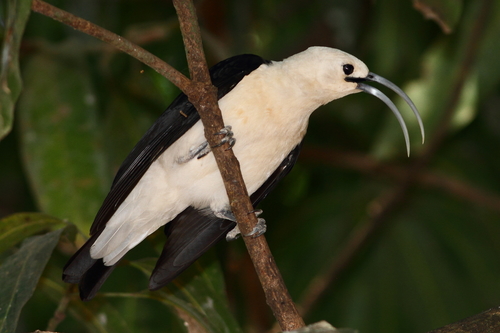
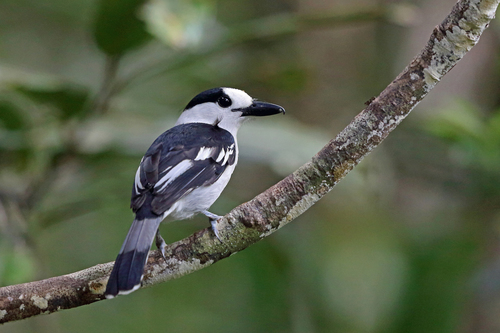
The hook-billed vanga, with the scientific name Vanga curvirostris, is a species of bird belonging to the Vangidae family. This species is endemic to Madagascar. Its natural habitats are subtropical or tropical dry forest, subtropical or tropical moist lowland forest, and subtropical or tropical moist montane forest. In 1760, French zoologist Mathurin Jacques Brisson included a description of the hook-billed vanga in his work Ornithologie, based on a specimen collected from Madagascar. Brisson used the French name L'écorcheur de Madagascar and the Latin name Collurio Madagascariensis for the species. Although Brisson created these Latin names, they do not follow the binomial system and are not recognized by the International Commission on Zoological Nomenclature. In 1766, Swedish naturalist Carl Linnaeus updated his Systema Naturae for its twelfth edition, adding 240 species that had previously been described by Brisson. The hook-billed vanga was one of these added species. Linnaeus provided a brief description of the species, created the binomial name Lanius curvirostris, and cited Brisson's earlier work. This species is now the only species placed in the genus Vanga, which was introduced by French ornithologist Louis Pierre Vieillot in 1816. The genus name Vanga comes from the Malagasy name for this species. The specific epithet curvirostris derives from Latin, where curvus means 'curved' and -rostrum means 'billed'. Two subspecies of Vanga curvirostris are currently recognized: V. c. curvirostris (Linnaeus, 1766), which is found in west, north, and east Madagascar, and V. c. cetera Bangs, 1928, which is found in south Madagascar. A 2018 study focused on avian skull evolution concluded that the ancestral neornithe had a beak most similar to the beak of this species. This finding suggests the ancestral neornithe occupied a similar ecological niche to that of modern hook-billed vangas.