About Vanessa cardui (Linnaeus, 1758)
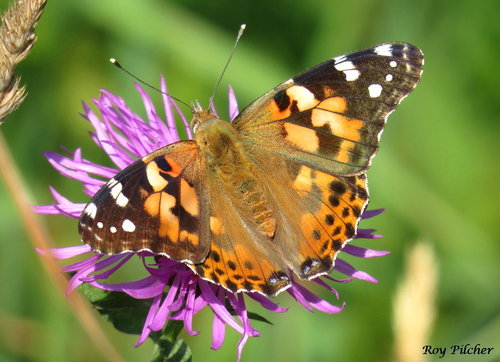
Description of males and females: Upperside. The base ground color is reddish-ochreous, and the basal areas are olivescent-ochreous-brown; the cilia are black, alternating with white. On the forewing, an outwardly-oblique, irregularly shaped broken black band crosses from the middle of the cell to the disc above the submedian vein; the apical area starting from the end of the cell and the exterior border are also black. Just before the apex, there is a short, outwardly-oblique white streak and a curved row of four round spots, with the second and third spots being small. A marginal pale lunular line runs across, with its upper portion the most clearly defined and whitish in color. On the hindwing, there is a blackish patch extending from the costal vein across the end of the cell, a partly confluent recurved discal band, a submarginal row of lunules, and then a marginal row of somewhat scutiform spots. Between the discal band and the submarginal lunules is a row of five round black spots, which in some specimens show a pale and dark outer ring. Underside. The forewing is a brighter reddish-ochreous, with the apical area and outer margin much paler, and the apex olivescent ochreous-brown; the irregular discal band matches the pattern seen on the upperside, while the subapical white streak, row of spots and marginal lunules are all distinct; the base of the wing and the interspace before the end of the cell are white. The hindwing is transversely marbled with olivescent ochreous-brown and speckled with black scales; it is crossed by basal and discal sinuous whitish or pale fascia and intersected by white veins; there is an outer-discal row of five ocelli, where the upper ocellus is the smallest and usually imperfect, the second and fifth are the largest, the fourth has a black center speckled with blue and is ringed with yellow, and the second and fifth also have an outer black ring; the submarginal lunules are purpurescent-grey, bordered by a whitish fascia; the outer margin is ochreous. The body is olivescent ochreous-brown, with the abdomen marked by ochreous bands; the palpi are blackish on the upper side and white on the underside; the underside of the body and the legs are greyish-white; the antennae are black on the upper side, with the tip and underside reddish. Distribution. Vanessa cardui is one of the most widespread butterfly species in the world, found on every continent except Antarctica and South America. In Australia, Vanessa cardui has a limited range restricted to areas around Bunbury, Fremantle, and Rottnest Island. However, its close relative, the Australian painted lady (Vanessa kershawi, sometimes considered a subspecies of V. cardui), ranges across more than half of the Australian continent. Other closely related species include the American painted lady (Vanessa virginiensis) and the West Coast lady (Vanessa annabella). Food sources and host plants. Larvae of V. cardui feed on species in the Asteraceae family, including Cirsium, Carduus, Centaurea, Arctium, Onopordum, Helianthus, and Artemisia. According to the HOSTS database, the painted lady has over 300 recorded host plant species. Adult butterflies feed on flower nectar and aphid honeydew.