About Vanellus miles (Boddaert, 1783)
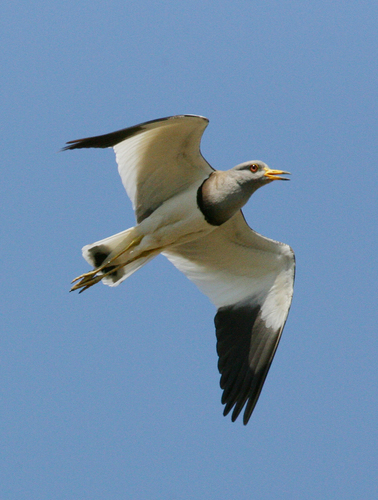
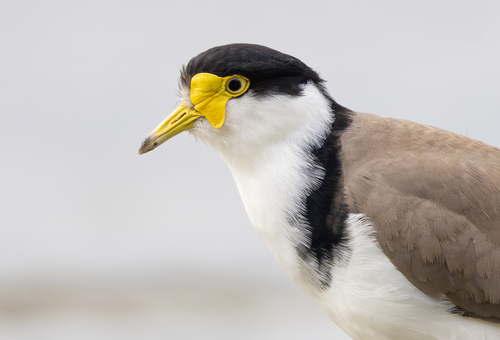
This species, commonly called the masked lapwing, has the scientific name Vanellus miles (Boddaert, 1783). It is the largest member of the plover and lapwing family Charadriidae. Adults measure 30 to 37 cm (12 to 15 inches) in total length, with a wingspan ranging from 75 to 85 cm (30 to 33 inches). Each wing has a clearly visible yellow spur at the carpal joint. Body mass differs by subspecies: the nominate subspecies V. m. miles weighs 191 to 300 grams (6.7 to 10.6 ounces), while the southern subspecies V. m. novaehollandiae is larger and weighs 296 to 412 grams (10.4 to 14.5 ounces).
V. m. miles, the subspecies native to northern Australia and New Guinea, has an entirely white neck and large yellow facial wattles. Males of this subspecies have a distinct facial mask and larger wattles than females. V. m. novaehollandiae, found in southern and eastern Australian states and in New Zealand, is often locally referred to as the spur-winged plover; it has a black stripe across its neck and smaller wattles. Note that the northern-hemisphere spur-winged plover is an entirely different species. Masked lapwings produce a wide variety of calls that can be heard at any time of day or night, including warning calls, loud defensive calls, courtship calls, and calls directed at their young. Because this species lives on the ground, individuals stay constantly alert; even when resting, they never enter full deep sleep.
Masked lapwings are most common around the edges of wetlands and other moist open environments, but they are highly adaptable and can often be found in surprisingly dry arid areas. They also occur on beaches and along coastlines. The subspecies V. m. novaehollandiae spread naturally to Southland, New Zealand, in the 1930s, and has since expanded its range across the whole of New Zealand. In New Zealand, it is classified as a self-introduced native and is known by the common name spur-winged plover.