About Vanellus leucurus (M.H.K.Lichtenstein, 1823)
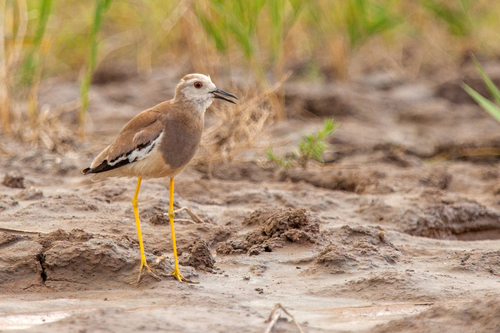
The white-tailed lapwing, also called the white-tailed plover, scientific name Vanellus leucurus, is a wading bird in the lapwing genus Vanellus. The genus name Vanellus comes from Medieval Latin for lapwing, originating from vannus, the word for a winnowing fan. The specific epithet leucurus comes from Ancient Greek leukouros, meaning "white-tailed". This is a medium-sized lapwing with long legs and a fairly long bill. It is the only lapwing that is commonly found in areas other than very shallow water, where it feeds by picking insects and other small prey mainly from surface substrates. Adult white-tailed lapwings are slim, upright birds with a brown back and foreneck, a paler face, and a grey breast. Their long yellow legs, pure white tail, and distinctively patterned brown, white, and black wings make this species easy to identify. Juvenile birds have a scaly pattern on their back, and may have some brown colouring in their tail. Its breeding season call is a peewit sound, similar to the call of the northern lapwing. This species breeds semi-colonially on inland marshes in Iraq, Kuwait, Iran, and southern Russia. Females lay four eggs in a nest built on the ground. Populations breeding in Iraq and Iran are mainly resident, while birds breeding in Russia migrate south for the winter to the Indian subcontinent, the Middle East, and northeast Africa. It is a very rare vagrant in western Europe; the first recorded individual in Britain was found at Packington, Warwickshire on 12 July 1975. In some parts of its distribution range, the species faces threats linked to habitat destruction and unintentional poaching. The white-tailed lapwing is one of the species covered by the Agreement on the Conservation of African-Eurasian Migratory Waterbirds (AEWA).