About Vanellus indicus (Boddaert, 1783)
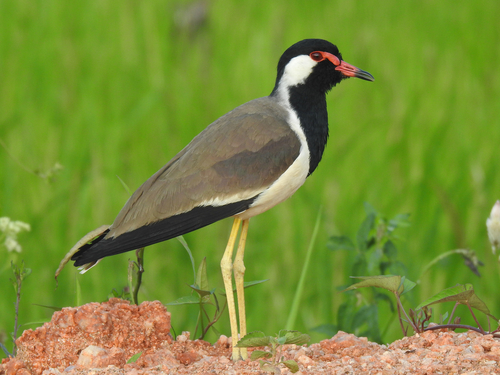
Red-wattled lapwings (scientific name Vanellus indicus (Boddaert, 1783)) are large waders, approximately 35 cm (14 in) in total length. Their wings and back are light brown with a purple to green iridescent sheen, while their head, and a bib covering the front and back of the neck, are black. A prominent white patch runs between these two color sections, stretching from the belly and tail, along the sides of the neck to the sides of the crown. Their short tail is tipped with black, each eye has a red fleshy wattle in front, the bill is red with a black tip, and their long legs are yellow. In flight, prominent white wing bars are formed by white coloration on the secondary coverts.
Several geographic subspecies are recognized: the aigneri subspecies, which is slightly paler and larger than the nominate race, found in Turkey, Iran, Iraq, Afghanistan and the Indus valley; the nominate race found across all of India; the smaller, darker Sri Lankan race lankae; and the atronuchalis race found in north-eastern India and eastern Bangladesh, which has a white cheek surrounded by black.
Males and females have similar plumage, but males have 5% longer wings on average, and tend to have a longer carpal spur. Standard measurements for the species are: total length 320–350 mm; wing length 208–247 mm, with the nominate race averaging 223 mm, and the Sri Lankan race averaging 217 mm; bill length 31–36 mm; tarsus length 70–83 mm; tail length 104–128 mm. Rare leucistic abnormal plumages have also been recorded.
Red-wattled lapwings most often occur in pairs or trios in well-watered open country, ploughed fields, grazing land, and the margins and dry beds of tanks and puddles. They will occasionally form large flocks, ranging from 26 to 200 individuals. They are also found in forest clearings around rain-filled depressions. They move in short running spurts, and dip forward obliquely with unflexed legs to pick up food, which is a feeding pattern typical of plovers. They are reported to feed at night, and are especially active around the full moon. They are extremely and continuously alert both day and night, and are always the first to detect intrusions and raise an alarm, which made them considered a nuisance by hunters. Their flight is rather slow, with deliberate wing flaps, but they can move with remarkable agility when defending their nest or escaping a hawk. They have a striking appearance and a noisy nature, producing a loud, scolding did-he-do-it call both day and night. Local common names for the species are mainly onomatopoeic, including titahri (Hindi), titawi (Marathi), tittibha (Kannada), tateehar (Sindhi), titodi (Gujarati), hatatut (Kashmiri), balighora (Assamese), yennappa chitawa (Telugu), and aal-kaati (Tamil, meaning "human indicator").
This species breeds from West Asia including Iraq, southwest Iran and the Persian Gulf eastwards across South Asia including Baluchistan, Sri Lanka, Afghanistan, Pakistan, and the entire Indian subcontinent up to Kanyakumari, and occurs up to 1800m in Kashmir and Nepal, with another subspecies extending further east into Southeast Asia. Populations may make altitudinal migrations in spring and autumn, for example in northern Baluchistan or northwest Pakistan, and spread widely across the landscape during monsoons when suitable habitat becomes available, but overall most populations are resident. The species is declining in its western range, but is abundant across much of South Asia, and can be found in almost any wetland habitat within its range.
The breeding season is mainly from March to August. During courtship, the male puffs out his feathers, points his beak upwards, then shuffles around the female. Multiple males may display to females close to one another. Eggs are laid in a ground scrape or depression, sometimes lined with pebbles, or goat or hare droppings. Clutches contain about 3–4 black-blotched buff eggs shaped roughly like a peg-top (pyriform), with an average size of 42x30 mm. Nests are hard to locate because the cryptically colored eggs blend in with the surrounding ground pattern. In residential areas, red-wattled lapwings will occasionally nest on rooftops. They have also been recorded nesting on the stones between railway tracks, with adults leaving the nest when trains pass. When nests are threatened by agricultural operations, people have manually translocated nests by gradually shifting the eggs to new locations. When nesting, the birds will attempt to dive bomb or distract potential predators. Both the male and female incubate the eggs, divert predators using distraction displays, or flash their wings to deter herbivores that threaten the nest. Males typically relieve females from incubation during the hot midday period. Eggs hatch after 28 to 30 days. Overall reproductive success is around 40%, with high egg mortality of roughly 43% caused by predation from mongooses, crows and kites. Chick mortality is lower at 8.3%, and chick survival improves after the first week. Like other lapwings, they soak their belly feathers to carry water to their chicks and cool eggs during hot weather. They bathe in pools of water when available, and will often spend time preening after leaving the nest or after copulation. They sometimes rest on the ground with their tarsi laid flat, and other times will rest on one leg. Healthy adult red-wattled lapwings have few natural predators, and are capable of rapid, agile flight when pursued by hawks or falcons. Hugh B. Cott recorded that the flesh of this bird is unpalatable, based on a report from an Indian geologist who observed that a hungry tiger cub refused to eat their meat. Several types of endoparasitic tapeworms, nematodes, and trematodes have been documented in this species. Mortality from respiratory infection caused by Ornithobacterium rhinotracheale has been recorded in captive birds in Pakistan.