About Vanellus gregarius (Pallas, 1771)
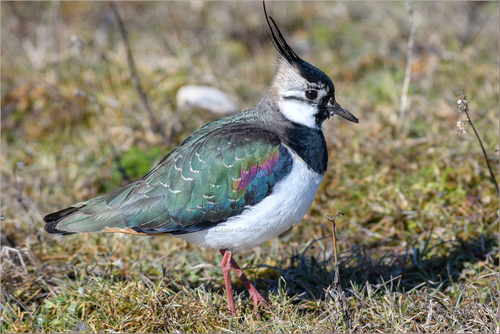
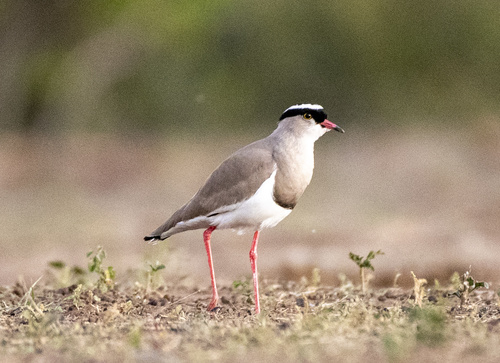
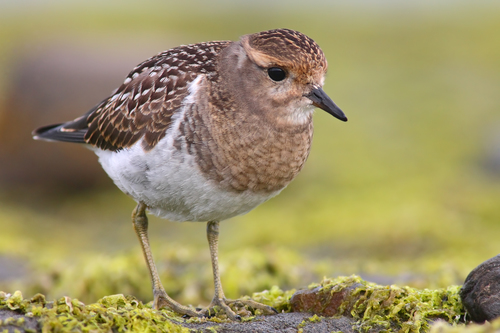
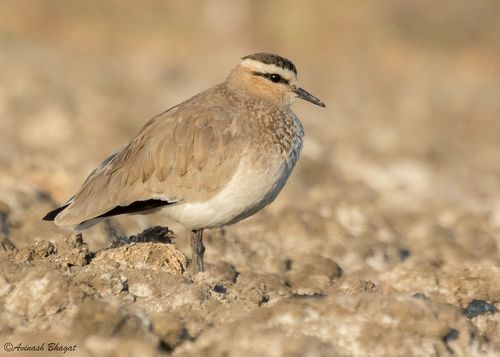
This is a medium-sized lapwing species, Vanellus gregarius, with moderately long black legs and a short black bill. It measures 27–30 cm (11–12 in) in length, and its call is a harsh kereck. Non-breeding winter-plumage individuals have light brown wings and a distinct head pattern: the crown is black, with a black eyestripe bordered above and below by white. The underside is white. In flight, the species is nearly unmistakable due to its moderately long black legs, white tail with a black terminal band, and distinctive brown, white, and grey wings. Breeding summer plumage is more vivid; most brown feathers become greyish and slightly glossy, while the cheeks are ochre. The eye stripes and crown are darker and more defined, and the lower breast develops black plumage that fades to rich chestnut-colored feathers near the vent. Juveniles have scaled-looking backs from edged feather margins, and only faint traces of the adult head pattern. Vanellus gregarius resembles the more common white-tailed lapwing, but can be distinguished by its striped crown and dark grey legs; white-tailed lapwings have yellow legs and a plain unstriped head. Unlike most other lapwings that favor wetter aquatic habitats, the sociable lapwing prefers steppes, arid grasslands, and cultivated fields. It breeds in the steppes of Kazakhstan, and lays three to four eggs in a ground nest. Historically, the species followed two migration routes: western and eastern. Birds on the western route migrate through Central Asia and Turkey to winter in Israel, Palestine, Lebanon, selected regions of Saudi Arabia, and Eastern Africa. Birds on the eastern route winter in coastal Iran, the United Arab Emirates, and India. Historically, the sociable lapwing was only recorded as a vagrant in Qatar and Kuwait, with the first confirmed sightings in the 1980s. After industrialization led to the creation of widespread farms and parks in both countries, vagrants began visiting sites including Rukaiya farm and Sulaibyia pivot fields repeatedly starting in the early 2000s, and now some even winter here, forming a new third central migration route. The species once occupied a large range across Europe, but is now effectively extirpated from the continent. Remnant members of the former Ukrainian population migrate to the Iberian Peninsula, where up to five individuals spend the winter each year. Migrant and vagrant individuals have been observed in nearly every European country and the French Empire, often found alongside Northern lapwings during migration. Like the Northern lapwing, it feeds by picking insects and other small prey mainly from grassland or arable land.