About Vanellus armatus (Burchell, 1822)
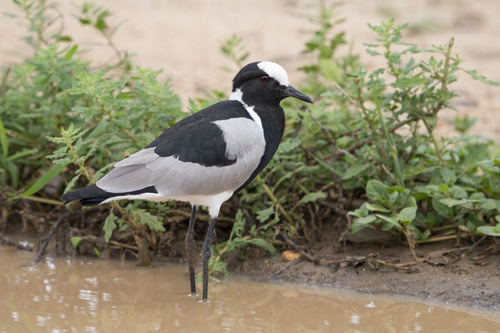
Vanellus armatus, commonly called blacksmith lapwings, have a very bold, contrasting plumage pattern in black, grey, and white, which may act as a warning color to predators. It is one of five lapwing species (two African, one Asian, two Neotropical) that share red eyes, bold pied plumage, and a carpal spur on the wrist joint. This spur is a sharp black protrusion that the birds use to aggressively defend their young from potential threats, by carrying out persistent aerial dives that usually target the head of the intruder. The body parts of this bird not covered by feathers have an average black coloration on the bill, and legs that are either solid black or dappled with white and grey. Females are on average larger and heavier than males, but the two sexes are generally similar in appearance. Blacksmith lapwings live in association with wetlands of all sizes, and even very small damp areas created by spilled water from troughs can attract them. In South Africa, they are most abundant in the mesic grassland region, and less common in higher-rainfall grasslands. Similar to the crowned lapwing, this species may leave Zambia and Zimbabwe in years with high rainfall, and return during dry years. It avoids all types of mountains. During the 20th century, blacksmith lapwings expanded their range into areas where dams were built and intensive farming was practiced. As a result, they are now numerous and established in the Western Cape region of South Africa, an area where they were absent until the 1930s. In this region, they also move into estuarine mud flats during winter, where they aggressively displace other wader species. While blacksmith lapwings are partially migratory, they do not appear to complete large-scale, regular migrations. During the breeding season, this species often reacts aggressively to other lapwings or African jacanas that enter its wetland habitat. Their nests are shallow depressions built on bare ground or short grass, located close to water, and nests are typically spaced at least 400 meters apart. Blacksmith lapwings breed in spring, but their choice of nesting site and breeding timing can be opportunistic. Young birds separate gradually from their parents and do not return to their natal areas after leaving. This lapwing feeds on both aquatic and terrestrial invertebrates.