About Vandenboschia boschiana (J.W.Sturm ex Bosch) Ebihara & K.Iwats.
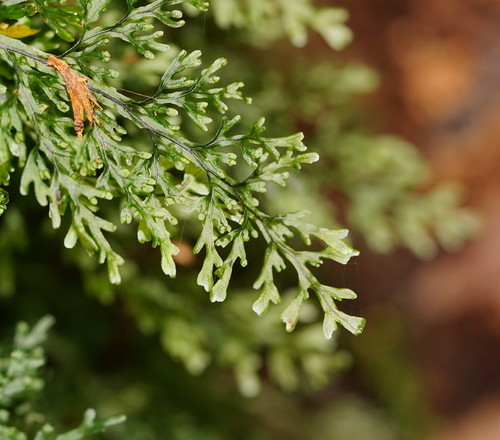
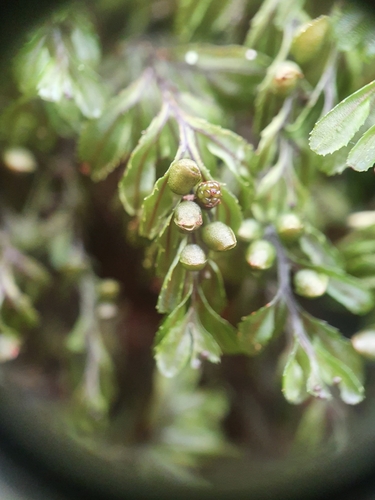
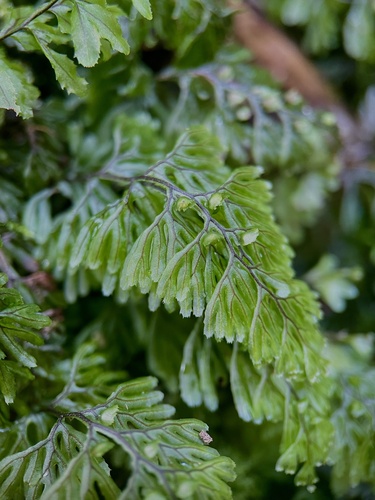
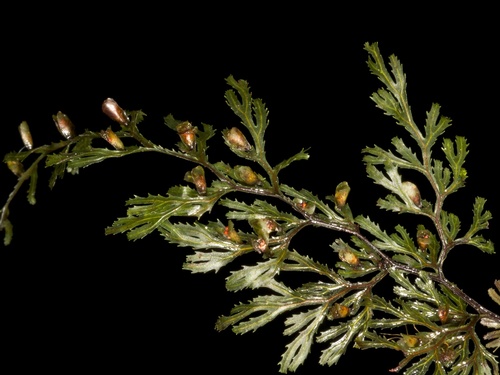
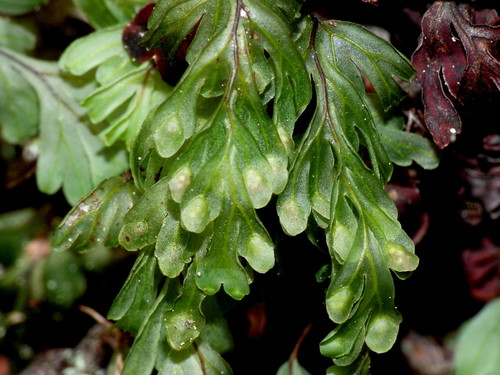
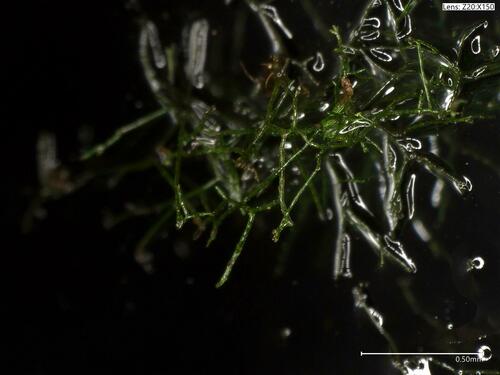
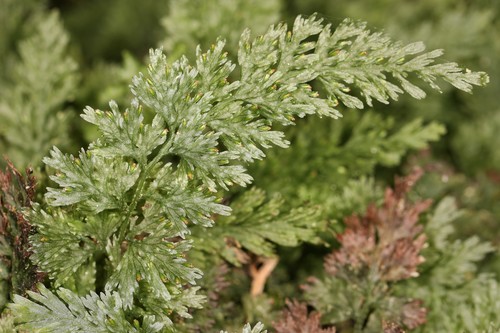
This species has the accepted scientific name Vandenboschia boschiana (J.W.Sturm ex Bosch) Ebihara & K.Iwats. Its evergreen fronds are bipinnatifid, deeply and irregularly dissected. Fronds measure about 4 to 20 cm long and 1 to 4 cm across, with winged stipes that are 1 to 7 cm long, and are light green in colour. Its common name comes from its very thin leaves, which are only a single cell thick, lack an epidermis, and are translucent, giving them an appearance like a wet film. Spore-producing organs called sori form along the margins of frond segments. An indusium forms a funnel around each sorus, which is sunken into the leaf tissue. A bristle-like receptacle protrudes from the indusium, a trait shared by all Trichomanes species. Spore production takes place between July and September. Like all ferns, V. boschiana has a gametophyte stage in its alternation of generations life cycle, and develops a haploid reproductive prothallus that grows as an independent plant. Unlike the typical heart-shaped fern prothallus, V. boschiana gametophytes are filamentous, and resemble colonies of green algae or moss protonemata. This species is endemic to eastern North America. Its populations occur in the eastern United States, ranging from southern Ohio in the north to Alabama in the south, and from Arkansas and southern Illinois in the west to South Carolina in the east. Across its entire range, populations are very scattered, matching the distribution of its uncommon required habitat. Vandenboschia boschiana grows in deep shade on damp acid rocks, most commonly sandstone, in sheltered canyons, grottos, and rock shelters, at altitudes between 150 and 800 m. The rock outcrops it grows on are typically located within mesic upland forests. This fern relies on consistently high air humidity, which severely limits its distribution under the current climate of eastern North America. It is thought to be a relict left over from milder pre-glacial conditions. Its current distribution is believed to reflect a combination of historical lack of glaciation, appropriate substrate and bedrock type, lack of disturbance in the surrounding forest, and suitable micro-climate. Temperature is thought to be a less influential limiting factor than these characteristics, though extreme cold weather can cause mortality. Periodic droughts cause heavy mortality, and have reduced the size of many populations over the past few decades. The species is likely more at risk of extinction than its G4 global conservation grading would suggest, and state-level NatureServe conservation rankings for this species range from Vulnerable (S3) to Critically imperiled (S1). Major threats to the species include habitat drying, removal of the forest canopy that shades its rock growing sites, and over-collecting. Vandenboschia boschiana is not known to be widely cultivated. Based on its broad geographic distribution, the species may be hardy in USDA Zone 6, though this does not account for the specialized micro-climate of its native sheltered habitat.