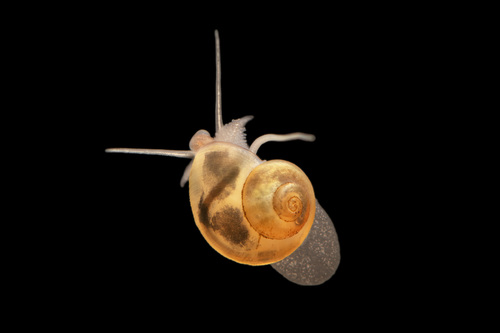
About Valvata piscinalis (O.F.Müller, 1774)
This section details the shell characteristics of Valvata piscinalis, also called the European valve snail. Its shell has a somewhat pinched aperture and an attenuate spire, and spire height tends to increase in more eutrophic conditions. Most shells have four or five whorls, are white to beige, and show more orange to red pigmentation on the apical region. The operculum has approximately 10 spiral markings that originate almost at its center. The European valve snail can be mistaken for Valvata sincera, a native species of the Great Lakes. The North American Valvata sincera differs from the introduced Valvata piscinalis by having a more spherical aperture, a wider umbilicus, a conical spire, and more widely spaced, rough growth lines on the shell. In the Great Lakes, introduced mature adult European valve snails reach 5 mm in height and 3–5 mm in width. In Europe, this species can grow up to 7 mm high and 6.5 mm wide, though individuals are usually smaller. Shell dimensions for recognized subspecies are as follows: Valvata piscinalis piscinalis has a shell width of 4–5 mm and a shell height of 3–4.5 mm; Valvata piscinalis antiqua has a width of 4.5 mm and a height of 6 mm; Valvata piscinalis geyeri has a width of 2.5 mm and a height of 3 mm; Valvata piscinalis discors has a width of 3 mm and a height of 3 mm; Valvata piscinalis alpestris has a width of 6.3 mm and a height of 5.5 mm.
Valvata piscinalis is native to the Palearctic realm, and is also an introduced species widespread in parts of North America. It has declined across some areas of its native distribution and is considered endangered in several regions. Its indigenous range covers the British Isles, all of Europe, extending east through Asia Minor to Tibet; it is also native to Europe, the Caucasus, western Siberia and Central Asia, where it is common in many freshwater environments. It is not found in Iceland at all. Specific native regional conservation statuses include: it is endangered in Austria; its status is recorded in Croatia; it is near threatened (NT) in both Bohemia and Moravia, Czech Republic; it is recorded in Slovakia; it is recorded in Poland; in Germany, it is on the species watchlist, listed as critically endangered in Saxony and Thuringia, endangered in Berlin, declining (4R) in Bavaria, a species with limited distribution in Brandenburg, and on the species watchlist in Hesse and North Rhine-Westphalia, and is common in all other German federal states; it is present in the Netherlands; it is present in Great Britain and Ireland; it is not listed on the Swedish red list; it is present in India. As a nonindigenous species, Valvata piscinalis occurs in the United States. It was first introduced to Lake Ontario at the mouth of the Genesee River in 1897. Over 40 years, it dispersed to Lake Erie, then expanded its range to the Saint Lawrence River, the Hudson River, Lake Champlain and Cayuga Lake. It was recorded in Superior Bay of Lake Superior (Minnesota), Lake Michigan (Wisconsin), and Oneida Lake in the Lake Ontario watershed (New York State) during the 1990s and the first decade of the 21st century.
This small snail lives in freshwater streams, rivers, and lakes, and prefers running water while being able to tolerate water with low calcium levels. In its native range, it is associated with oligotrophic nearshore zones, and occurs more often in clear-water habitats than turbid water. It is found in sparsely vegetated lakes, or sites dominated by Chara spp. and Potamogeton spp., littoral habitats with high siltation rates, lentic stagnant waters or slow streams, and fine substrates such as mud, silt and sand, particularly during hibernation. It uses aquatic macrophytes as a surface to lay its egg masses. This species is somewhat resistant to macrophyte cover decline, as populations have been recorded surviving in ponds even after vegetation cover almost completely disappeared. In the Great Lakes, it occurs at depths ranging from 0.5 m to 23 m, while in Europe it is usually found at depths up to 10 m. Valvata piscinalis tolerates a wide range of calcium concentrations, and generally does not need very high temperatures to survive. Individuals can overwinter in mud, and often grow during this cold period, though some populations may experience mortality in frozen littoral zones. This species can tolerate salinities up to 0.2%, and occurs in the northern parts of the Curonian Lagoon, where it is exposed to periodic intrusions of saline water that last for a few hours or days.
Valvata piscinalis grows rapidly and has high fecundity. It is a hermaphroditic species that reproduces with one individual acting as male and the other as female, and has no free larval stage. It may spawn 2 or 3 times per year, laying up to 150 eggs per spawning event that are deposited on vegetation. Hatching typically occurs between 15 and 30 days after laying. Individuals breed when they are around 1 year old, and usually die at 13 to 21 months of age. In Europe, breeding takes place from April to September, and occurs later at more northerly latitudes. Myzyk (2007) published a description of the life cycle of Valvata piscinalis.

