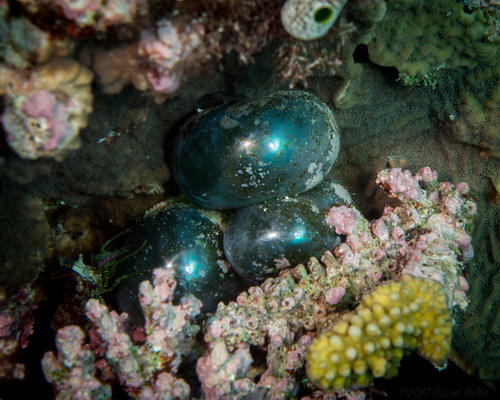
About Valonia ventricosa J.Agardh
Valonia ventricosa has a coenocytic structure containing multiple nuclei and chloroplasts. This organism has a large, multilobular central vacuole, with lobules radiating out from a central spheroid region. The entire cell holds several cytoplasmic domains; each domain contains one nucleus and a small number of chloroplasts. These cytoplasmic domains connect to each other through cytoplasmic "bridges" that are supported by microtubules. The peripheral cytoplasm, whose membrane is covered by the cell wall, is only around 40 nm thick. Valonia ventricosa usually grows individually, though it may occasionally grow in groups. This alga is found in tidal zones of tropical and subtropical regions, including the Caribbean, ranging north through Florida and south to Brazil, as well as in the Indo-Pacific. Overall, Valonia ventricosa inhabits every ocean across the world, and most often grows within coral rubble. The maximum recorded depth at which this species can survive is approximately 80 metres, or 260 feet.

