About Valgus hemipterus (Linnaeus, 1758)
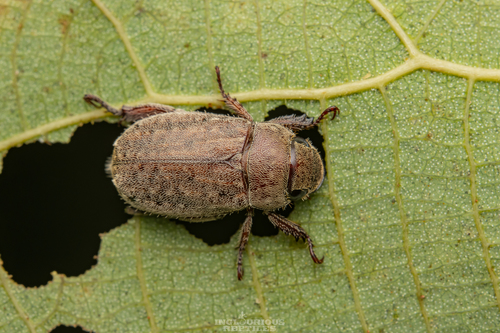
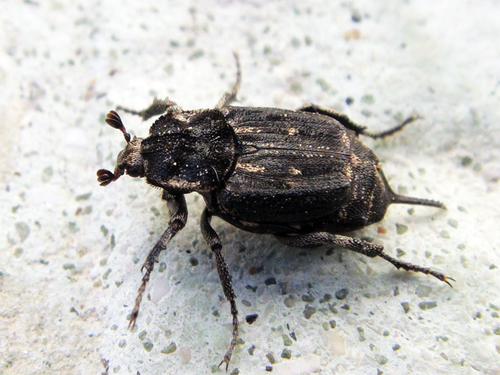
Valgus hemipterus (Linnaeus, 1758) reaches a body length of 6–10 mm. Its base body color is black or dark brown. Males have dark brown body scales with a light pattern, while most scales on females are dark. The lateral edges of the pronotum are rather serrate, the transverse medial ridge is not well developed, and the basal margin is quite rounded. The elytra are shortened and do not cover the entire abdomen. Both the pronotum and elytra have patches of light-colored setae. Females have a distinct long, pointed telson with a central groove near the apex and irregular lateral serrations, a trait that is unusual among beetles, and this feature makes it easy to tell females apart from males. Additionally, males have a different scale pattern than females. This species occurs naturally from the Caucasus and Turkey to North Africa, as well as across southern and central Europe, including Albania, Austria, Belarus, Belgium, Bosnia and Herzegovina, Bulgaria, Central European Russia, Croatia, Cyprus, Czech Republic, Denmark, European Turkey, France, Germany, Greece, Hungary, Italy, Latvia, Lithuania, Luxembourg, Republic of North Macedonia, Northwest European Russia, Poland, Portugal, Romania, Slovakia, Slovenia, South European Russia, Spain, Switzerland, The Netherlands, Ukraine, and Yugoslavia. It has also been introduced to the Nearctic realm in parts of North America, specifically Ontario, Michigan, and Ohio. Valgus hemipterus can be found in a variety of habitats, including vineyards and urban areas. It is active during warm weather, when it visits flowers on various shrubs. Peak activity takes place on warm, cloudy days, or when sunlight is partially filtered through clouds. Males are typically found on flowers, while females walk along the ground in alleys and lawns, or on stumps, searching for mates or appropriate egg-laying sites. Females visit flowers less often than males. In late May and early June, breeding individuals may form large swarms, which disperse after breeding is complete.