About Valerianella radiata (Willd.) Dufr.
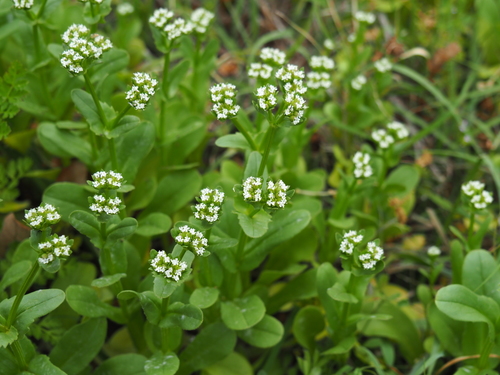
This species, with the accepted scientific name Valerianella radiata (Willd.) Dufr., is also referenced in this description under the synonym Valeriana woodsiana. It typically grows to 0.6 meters (2 feet) tall. Its stems are hollow, ascending to erect, angled, dichotomously branching, a key diagnostic feature, and glabrous to sparsely pubescent along stem wing margins. Leaves are arranged oppositely, with two leaves per stem node, and are simple, entire, and toothed. Basal leaves are either sessile or short-petiolate, spatulate to obovate, with bases fused around the stem, and glabrous along the margins and the underside midvein. Flowers are perfect, with both male and female organs, making the plant self-fertile. Flowers are bilaterally symmetrical, with 5 white petals and fused sepals. The corolla measures less than 2 mm in length. There are 3 stamens, one pistil formed from three carpels, an inferior ovary with 3 locules and one ovule per locule, and slightly 3-lobed stigmas. Small, dense inflorescences form in clusters, usually paired at branch tips, and have lanceolate to narrowly elliptic bracts. It produces dry fruit 2–2.5 mm long. Fruit is usually yellowish, ranging from glabrous to finely pubescent. Fertile fruit cells are slightly narrower than sterile cells, and a groove forms between the narrow fertile and sterile sides of the fruit. It is native to the deciduous forest regions of the eastern United States. It grows commonly in creek beds, roadsides, ditches, clearings, hilltops, and pasture lands, and tolerates habitats from moderate shade to full sunlight. It may occur as an introduced plant in Japan. This plant is not known to be toxic.