About Vahlodea atropurpurea (Wahlenb.) Fr.
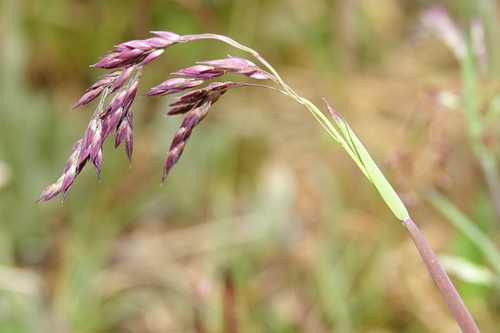
Vahlodea is a monotypic genus of plants in the grass family, with Vahlodea atropurpurea (Wahlenb.) Fr. as its only known species. This species has a native range extending from the subarctic region (including Greenland) to temperate areas of the Northern Hemisphere. In Europe, it is found in Finland, North European Russia, Norway and Sweden. In Asia, it occurs in Japan, Kamchatka, Kuril Islands, Magadan and Taiwan. In North America, it grows in the Canadian provinces of Alberta, British Columbia, Manitoba, Newfoundland and Labrador, Northwest Territories, Nunavut, Ontario, Québec and Yukon, and in the U.S. states of Alaska, the Aleutian Islands, California, Colorado, Idaho, Maine, Montana, New Hampshire, New York, Oregon, Vermont, Washington and Wyoming. It is also native to southern South America, in Argentina and Chile. The genus name Vahlodea honors Jens Vahl (1796–1854), a Danish botanist and pharmacist. The Latin specific epithet atropurpurea translates to dark-purple colored. Both the genus and its only species were first described and published in 1842, in Bot. Not. volume 141 on page 178. The genus is recognized by the United States Department of Agriculture and the Agricultural Research Service, which list Vahlodea atropurpurea as the only known species in the genus. Vahlodea was previously considered a synonym of Deschampsia P. Beauv., but a 2007 molecular phylogenetic study supported the recognition of both Avenella and Vahlodea as distinct genera.