About Vachellia farnesiana (L.) Wight & Arn.
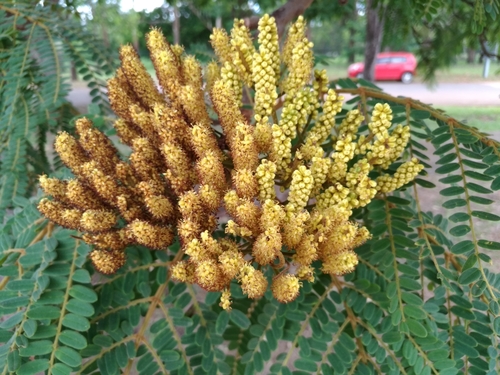
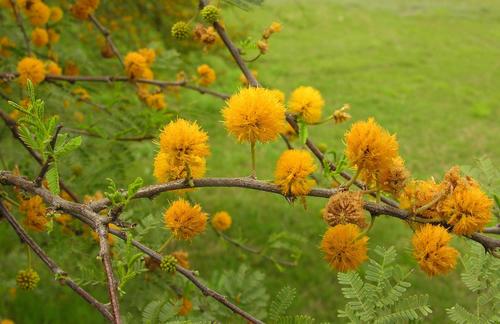
Vachellia farnesiana (L.) Wight & Arn. is deciduous across part of its range, but evergreen in most locations. It grows from multiple trunks and reaches a height of 4.6–9.1 metres (15–30 feet). Its bark is whitish gray, each leaf is paired with a set of thorns at its base on the branch, and its fruit is a dark brown seed pod. Among all acacia species, this plant has the widest distribution. Europeans first formally documented it in 1625, when Tobias Aldini described it from plants grown from seeds collected in Santo Domingo, which is now the Dominican Republic. Its native range has long been disputed. While its origin is generally thought to be the Caribbean, the Guianas, Mexico, and/or Central America, the species now has a pantropical distribution that covers most of the Americas (from the southern United States to Chile, excluding the Amazon), most of Australia, much of Africa, southern Europe, and southern Asia. In the Caribbean, it occurs from the Bahamas and Cuba south to Trinidad, Curaçao, and Aruba. It is thought to be native to Hispaniola and definitely native to Cuba, but its status as native or naturalized is uncertain in other parts of the region. In the United States, it is considered native to southern Texas, southern New Mexico, southern Arizona, and southern California, but likely naturalized in southern Louisiana, coastal Mississippi, coastal Alabama, coastal Georgia, and southern Florida. It remains debated whether the species' distribution outside the Americas is natural (its seed pods probably floated across the Pacific) or spread by human activity. It has been introduced to Europe, the Middle East, India, Africa, and more recently to Gran Canaria and Hawaii. It has long been thought to have reached the Philippines and Australia naturally, a claim supported by evidence: plants were collected there before colonization in 1788, the species is distributed widely across both regions, and Indigenous peoples have extensive traditional knowledge of the plant. A 2017 DNA investigation also found this origin most likely. Despite this, the Australian government currently classifies it as non-native and even invasive. This plant prefers full sunlight in tropical climates, and thrives in dry, saline, or sodic soils. Deer and peccaries eat its fruit, various bird species use it for nesting and cover, and insects feed on nectar from its flowers. If disturbed, it resprouts easily. In parts of Australia, it is considered a serious invasive pest that interferes with cattle ranching operations. It spreads quickly through commercial grazing pastures, especially along creeks, which can hinder farmer transport, complicate cattle mustering, and damage farm machinery. Cattle disperse its seeds after eating the nutritious pods, and overgrazing promotes further spread of the species. Ranchers use numerous herbicides to control it, and chemical control is currently the only method that can kill the plant. Human activity has spread V. farnesiana to many new areas, and it is classified as a serious weed in Fiji, where local people call it Ellington's curse. The plant's young leaves, flowers, and seed pods are edible raw or cooked. In traditional medicine, people in Brazil use V. farnesiana seeds to kill rabid dogs. It has been used in Colombia to treat malaria. One in vitro study found that an ethanol extract from its leaves showed some activity against the malarial pathogen Plasmodium falciparum, with an IC50 value of 1 to 2 microgram/millilitre (a result shared by almost all substances tested in the study). However, the extract showed no activity in animal models or in a ferriprotoporphyrin biomineralization inhibition test. In the Philippines, leaves are traditionally rubbed onto the skin to treat skin diseases in livestock. In Malaysia, an infusion of the plant's flowers and leaves is mixed with turmeric for post-partum treatment.