About Vachellia collinsii (Saff.) Seigler & Ebinger
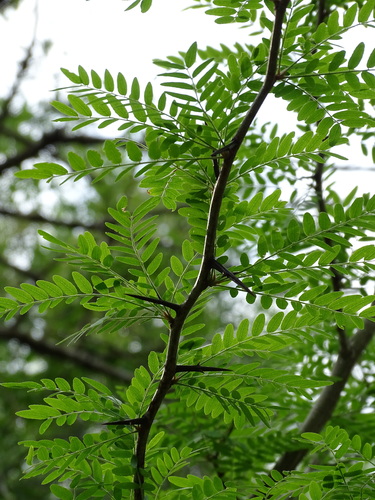
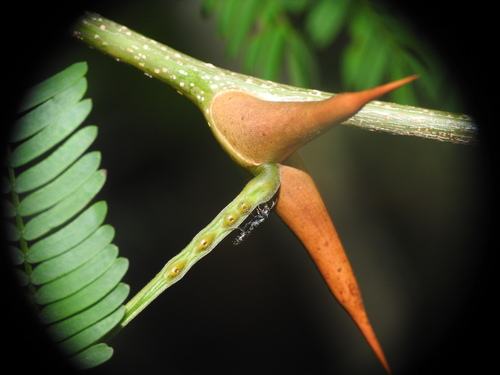
Vachellia collinsii is a tree species that can grow to over 40 feet tall. It typically grows with a straight trunk, and thorns are generously distributed across its branches. Its small, pinnate leaves grow opposite one another, similar to the leaves of a Mimosa. Because this species has a broad geological and ecological distribution, it displays a wide range of morphological traits. Even so, V. collinsii can be distinguished from other ant-acacias by several consistent features: elongated cylindrical inflorescences, somewhat small stipular spines, terete (cross-sectionally cylindrical) spines, 3 to 5 often dome-shaped petiolar glands, a complete lack of rachis glands, and leaflets with lateral veins. On the tree’s petioles, green bumps called extrafloral nectaries produce sugar that feeds symbiotic ants. V. collinsii has less suppression of lateral growth from the top to the base of the tree, which allows for more numerous, full branches near the base. This growth pattern creates a pyramid shape with a strong central trunk. Most tree species produce auxin that grows downward and suppresses lateral branch growth, but this is not the case for V. collinsii, because it does not have a strong apical meristem. As a result, the tree produces branches along its entire trunk length. The nectar from extrafloral nectaries is distinct from the nectar produced by the tree’s true yellow flowers. The tips of V. collinsii leaflets may produce Beltian bodies, which are protein- and lipid-rich food bodies produced as part of the tree’s symbiotic relationship with ants. Vachellia collinsii is native to Central America and parts of Africa. In southern Central America, where it occurs in seasonally dry ecosystems, it grows during secondary succession and prefers savanna-like climates. Like other acacias, V. collinsii prefers full sun and is rarely found in the understory of jungles. It can thrive in climates with humidity above 70%. Compared to other acacias, V. collinsii has a wide global distribution, as well as a wide ecological distribution, as it can grow at elevations ranging from sea level to 1000 meters. Vachellia collinsii forms a symbiotic relationship with several ant species, most notably Pseudomyrmex spinicola and Pseudomyrmex ferruginea. The ant-Vachellia system involving this species has been studied by ecologists such as Daniel Janzen in Palo Verde National Park and Santa Rosa National Park, both located in Guanacaste Province, Costa Rica. Ants chew holes into the tips of the tree’s hollow stipular thorns (called domatia) to enter and establish their colonies inside. A single ant colony may span multiple V. collinsii trees. Medium-sized herbivores are usually deterred by the tree’s thorns alone, but the ants help protect V. collinsii from other potentially threatening animals. Smaller animals such as caterpillars can easily avoid the thorns, and larger animals such as elephants are barely affected by them. When a attempting to feed, a predator brushes against and shakes the plant’s thorns; this disturbs the ants, which run outside and release alarm pheromones to alert other colony members. All ants that detect the alarm pheromones become aggressive and attack the intruding animal by biting and stinging. Beyond defending the tree from herbivores, ants living on V. collinsii may also cut down surrounding vegetation and trim encroaching branches from other plants. This gives V. collinsii valuable growing space and unobstructed access to sunlight, helping the tree thrive. In exchange for the ants’ protection and competitive clearing, V. collinsii provides ants with hollow thorns for nesting, as well as lipid- and protein-rich Beltian bodies on the tips of new leaflets that ants consume for critical nutrients. When V. collinsii is starved of nutrients, it produces more Beltian bodies to encourage ant colonization; when the tree has sufficient extra nutrients, it produces fewer Beltian bodies. This behavior forms a feedback loop. V. collinsii also provides ants with sugar-rich nectar from the extrafloral nectaries located on leaf petioles. Because multiple ant species may occupy a single V. collinsii, intraspecific interactions between ant species have been observed, particularly between Pseudomyrmex spinicola and Crematogaster brevispinosa. C. brevispinosa can take over trees already occupied by Pseudomyrmex spinicola or Pseudomyrmex nigrocinctus. It also commonly occupies dying or heavily damaged trees, or trees that were previously inhabited by other ant species. It has been hypothesized that hosting ant colonies gives the acacia an additional benefit: the tree may have receptors within domatia that detect ant feces and trigger nutrient absorption pathways in the stem tissue at the domatia. When ants defecate inside domatia, their feces contain nutrients from their food that can be used by the plant. This allows the plant to take up additional nutrients more quickly, because the nutrients do not need to travel upward from the roots. In terms of chemical ecology, symbiotic ants living on V. collinsii become alarmed when herbivores disrupt the plant’s leaf tissue. One such herbivore is the beetle Pelidnota punctulate, which only feeds on ant-acacias and is protected by its heavy cuticle. Tissue disruption of V. collinsii leaves releases the compound trans-2-hexenal, which ants detect as a kairomone. When exposed to samples of this compound, ants become alarmed and display alarm behavior. This compound is not found in the mandibular gland secretions of Costa Rican acacia ants, which are the likely source of the ants’ own alarm pheromones.