About Vaceuchelus ampullus (Tate, 1893)
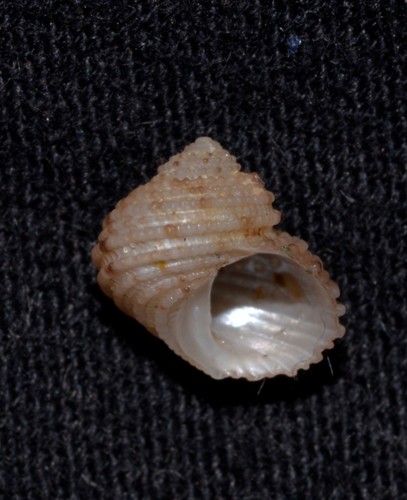
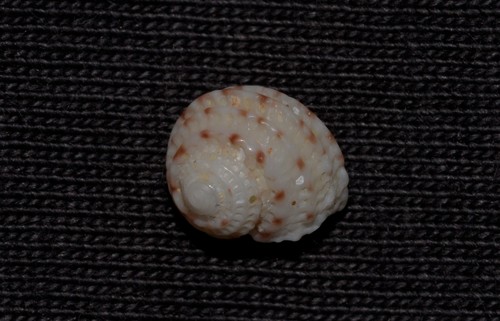
This is a description of the shell of Vaceuchelus ampullus (Tate, 1893). Young shells are globose-conic and imperforate, while adult shells are narrowly umbilicated or have only a fissure in place of a full umbilicus. The shell is whitish, with red spots located on its revolving ribs. The whorls of the spire are quadrate in shape, and are separated by a linear suture. The body whorl is convex, with only slight flattening at the suture. On the penultimate whorl, the sculpture consists of three equally thick, obtuse, and plain cinguli (spiral ornamentation bands), which are separated from each other and from the sutures by nearly equal interspaces. Each interval may or may not contain a small riblet. The entire shell surface is regularly clathrate, and the interstitial pits are narrowly oblong. The body whorl has approximately eight cinguli, with clathrate texture in the intervals; the supra-peripheral intervals each have a riblet. The four basal cinguli are granulose. The aperture is roundly oval. The outer and basal margins are smooth on the interior. The columella is arcuate, slightly explanulate, concave, and edentulous. This marine species is endemic to Australia, where it occurs in New South Wales, Queensland, South Australia, Tasmania, Victoria, and Western Australia.