About Vaccinium uliginosum L.
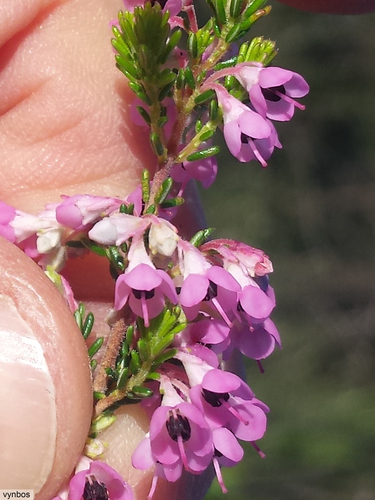
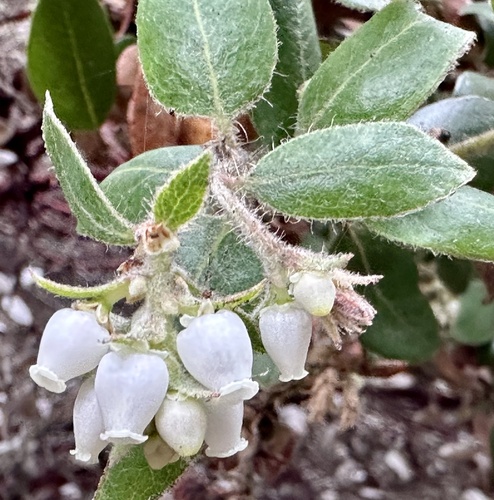
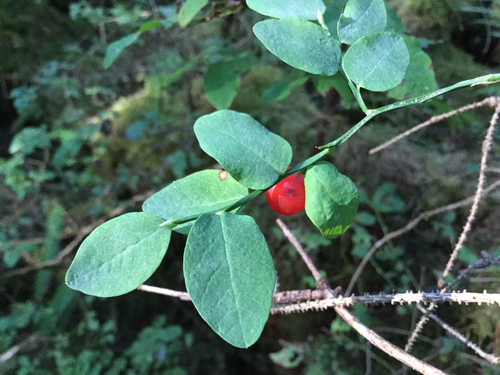
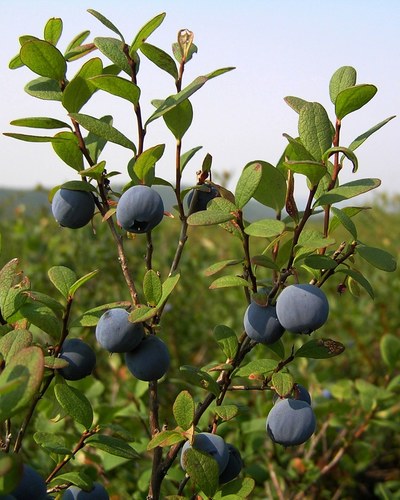
Vaccinium uliginosum L. is a small deciduous shrub. It usually grows 10 to 75 centimeters (4 to 29 and 1/2 inches) tall, and rarely reaches 1 meter (3 and 1/2 feet) tall. It has brown stems, which distinguishes it from the closely related common bilberry that has green stems. Its leaves are oval, 4 to 30 millimeters (1/8 to 1 and 1/8 inches) long and 2 to 15 millimeters (1/16 to 9/16 inches) wide. The leaves are blue-green with pale net-like veins, have smooth margins and rounded apexes. Its flowers are pendulous, urn-shaped, pale pink, 4 to 6 millimeters (3/16 to 1/4 inch) long, and are produced in mid-spring. It produces a dark blue-black berry 5 to 8 millimeters (3/16 to 5/16 inch) in diameter that has white sweet flesh, and the fruit ripens in late summer. The cytology of this species is 2n = 24. Its fruit persists for an average of 26.1 days, with an average of 24.7 seeds per fruit. Fruits are 86.8% water by average, and their dry weight contains 38.4% carbohydrates and 3.9% lipids. This plant is native to cool temperate regions of the Northern Hemisphere. It grows at low altitudes in the Arctic and the Baltics, and at high altitudes farther south: in Europe it ranges south to the Pyrenees, the Alps, and the Caucasus; in Asia it occurs in the mountains of Mongolia, northern China, the Korean Peninsula and central Japan; in North America it is found in the Sierra Nevada in California and the Rocky Mountains in Utah. It grows on wet acidic soils in heathland, moorland, tundra, and the understory of coniferous forests. Its elevational range extends from sea level in the Arctic up to 3,400 meters (11,200 feet) in the southern part of its range. V. uliginosum can survive long, severe climatic oscillations. The berries can be eaten raw or cooked, used to make jelly or pies, or dried to make pemmican. In Korean cuisine, bog bilberry is used to make infused liquor called Deuljjuk-sul.