About Vaccinium pallidum Aiton
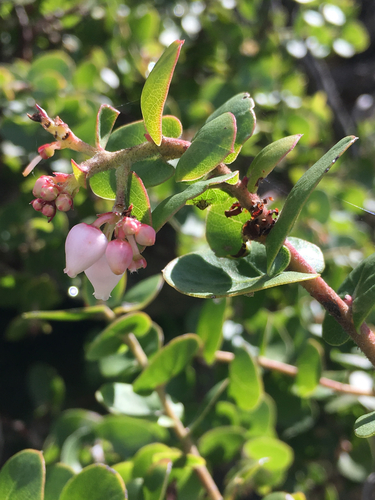
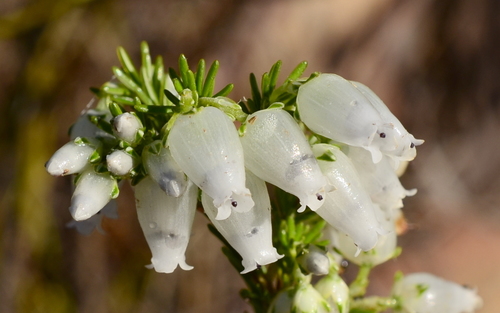
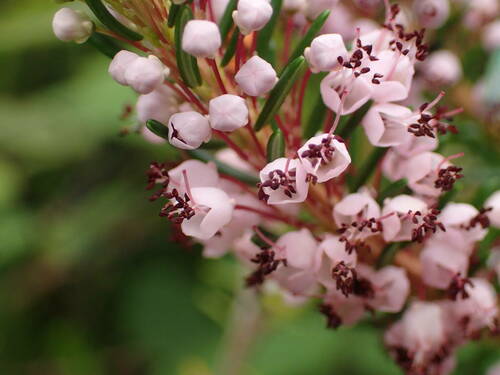
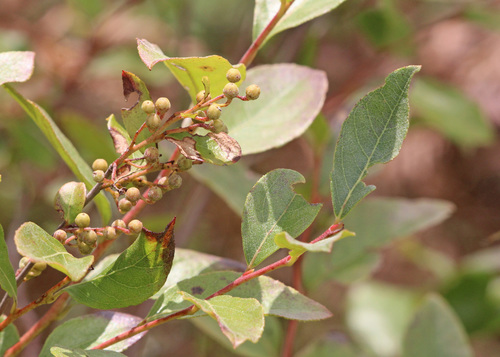
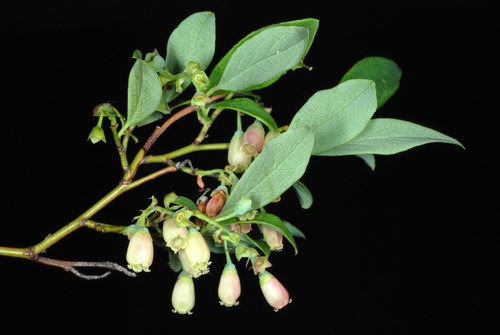
Vaccinium pallidum Aiton is a deciduous erect shrub with highly variable height. It most commonly grows 23 to 51 centimeters (9 to 20 inches) tall, though its total height can range from 8 cm (3 1⁄4 inches) to 1 meter (3 feet 3 inches) depending on environmental conditions. This species is colonial, sprouting from rhizomes to form large colonies of genetically identical clones. Its stems bear greenish brown to red bark, while smaller twigs may be green, reddish, yellowish, or gray. Its alternately arranged leaves are also variable; they are generally roughly oval, measuring 2 to 6 cm (3⁄4 to 2 1⁄4 inches) long. Leaf color ranges from green to yellowish or bluish, and leaves turn red in autumn. Flowers are cylindrical, bell-shaped, or urn-shaped, carried in racemes that hold up to 11 blooms each. Flower color ranges from white to pinkish or greenish, often appearing greenish white with pink striping, and flowers are about 0.5–1 cm (1⁄4–3⁄8 inches) long. These flowers are pollinated by bees, including bumblebees and Andrena carlini. The fruit is a berry that grows up to 1.2 cm long. Berry color ranges from waxy blue to shiny black, and rarely can be pure white. Each berry contains several seeds, and generally only a few of these seeds are viable. This plant reproduces both sexually via seeds and vegetatively by sprouting from its rhizome. Reported chromosome counts for this species are 2n = 24, 48. Vaccinium pallidum is native to central Canada (Ontario), the central and eastern United States (from Maine west to Wisconsin and south to Georgia and Louisiana), and the Ozarks of Missouri, Arkansas, southeastern Kansas and eastern Oklahoma. It grows in a wide range of habitat types, including oak and chestnut woodlands, maple-dominated swamps, pine barrens, pine savanna, and many other forest types. It occurs as an understory plant alongside trees such as red oak, black oak, white oak, post oak, chestnut oak, blackjack oak, Virginia pine, shortleaf pine, pitch pine, loblolly pine, longleaf pine, jack pine, eastern hemlock, red maple, and black cherry. It is common on disturbed sites such as roadsides and abandoned fields. It can also grow as a climax species in old-growth oak stands in the South Carolina piedmont. It can grow on dry rocky soils, sandy and gravelly soils, and heavy clay, in regions with generally humid climates. The wild berries are eaten as food by many types of birds and other animals. Each berry contains approximately eight calories. For human consumption, the taste is described as sweet to bland; the fruit can be eaten fresh, used in pies, or made into jelly. In some areas, including northeastern Alabama and northwestern Georgia, the fruit is harvested and sold commercially. The plant itself is also grown as an ornamental.