About Vaccinium ovatum Pursh
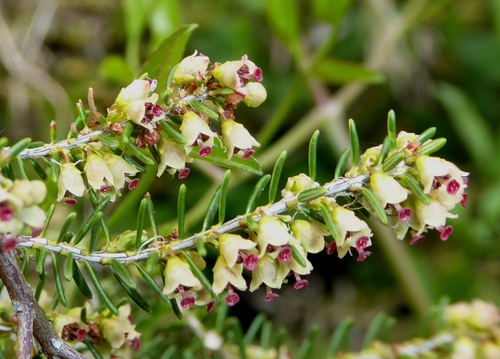
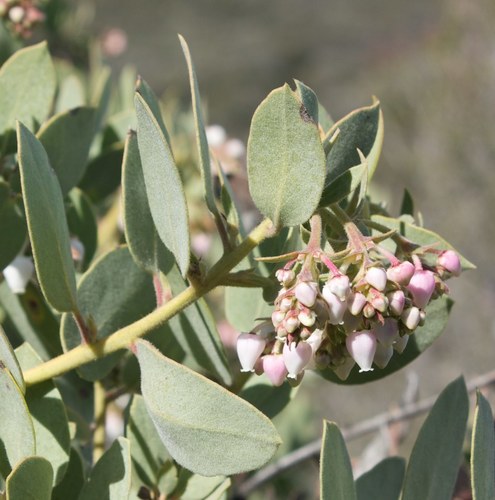
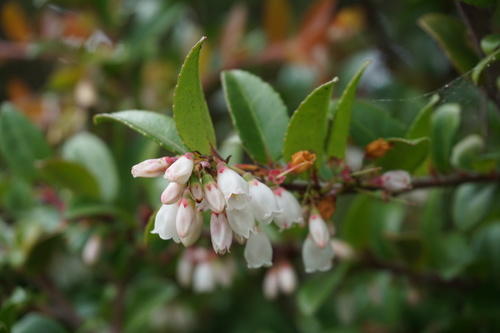
Vaccinium ovatum Pursh is an erect, slow-growing shrub that reaches 0.5 to 3 metres (1½ to 10 ft) in height. It has woody stems covered in bright red bark. Its leaves are waxy, alternately arranged, egg-shaped, finely serrated along the edges, measuring around 2 to 5 centimetres (¾ to 2 in) long and roughly 1 cm wide. Leaf color ranges from dark green to bright red, with higher sun exposure producing redder leaves. Vaccinium ovatum produces flowers from early spring through early summer; these blooms are white to light pink, urceolate, and hang downward from their supporting stem. The flowers are bisexual, containing both microgamete-producing and megagamete-producing organs, and have five floral parts. After flowering, they develop into a five-chambered fleshy berry. Berries ripen from summer into fall, remain on the shrub for up to a month before falling to the ground, and are dark purple to black when ripe, measuring just under 1 cm in diameter. The berries are tart, likely due to their high phenolic acid content that gives them a pH of approximately 2.6. Vaccinium ovatum is typically diploid, though rare naturally occurring tetraploids and lab-created tetraploids have been documented. Tetraploidy improves disease resistance in the plant through increased genetic diversity, and the diploid cytology count is 2n = 24. This species is native to British Columbia, Washington, Oregon, and California. It has a continuous distribution west of the Cascades, stretching from southern British Columbia to the redwood forests of the California Coast Ranges. While it is mostly coastal, it can be found up to 100 kilometres (62 mi) inland in southern Oregon. South of the redwood region, it occurs sporadically along the Coast Ranges extending to the western Transverse Ranges near Santa Barbara, and also grows on the California Channel Islands. Disjunct relictual populations grow on a few peaks in the Peninsular Range mountains of San Diego County, mostly on El Cajon Mountain, which marks the southernmost natural extent of the species. The primary habitat of V. ovatum features moist, well-drained, acidic soil. Like many plants, it grows well in full sun but is also highly tolerant of shade. These preferred conditions are common west of the Cascade Mountain range, where the species often thrives. Though it can grow at higher elevations in Southern California, it is primarily found in the coastal forests of Northern California, Oregon, Washington, and British Columbia, where it tolerates salt spray. It is an understory shrub that is often dominant in its native habitat. Common associated species growing nearby include Vaccinium parvifolium (red huckleberry) and Symphoricarpos albus (common snowberry). Vaccinium ovatum tends to thrive better in old-growth forests, most likely because it is slow-growing and requires more time to reach maturity. Vaccinium ovatum interacts with many other species for purposes ranging from resource competition to seed dispersal. It provides food for animals that facilitate its seed dispersal, and it relies on insect pollinators to disperse its pollen. It is also a common food source for migrating birds. Vaccinium ovatum is grown as an ornamental plant for horticultural use by specialty wholesale, retail, and garden nurseries. It grows successfully in natural landscape plantings, native plant gardens, habitat gardens, and public sustainable landscape and restoration projects that match its natural habitat conditions. It is not grown commercially for food production.