About Vaccinium ovalifolium Sm.
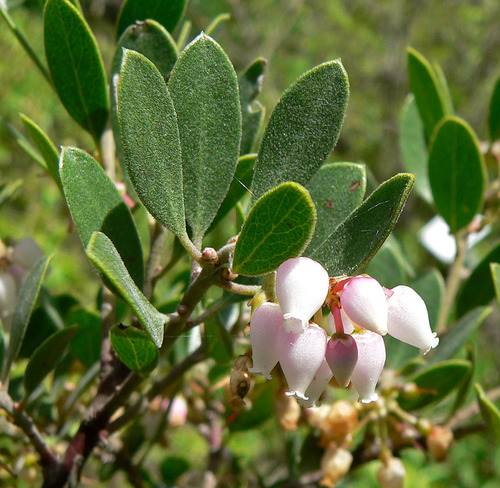
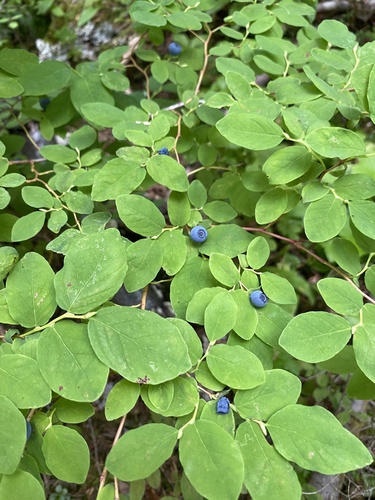
Vaccinium ovalifolium Sm. is a spreading shrub that can reach up to 2 meters (6 ½ feet) in height. Its leaves measure 2.5–3.5 centimeters (1–1 ½ inches) long, are green on the upper surface and pale underneath. This species produces pink, ¼-inch (0.64 cm) urn-shaped flowers. Its fruit are dark blue, often almost black, ¼–⅜ inch (0.5–1 cm) across, and sometimes covered in a waxy coating. Reported chromosome counts for this species are 2n = 24 and 2n = 72. The autonymic variety, Vaccinium ovalifolium var. ovalifolium, occurs on both the eastern and western coasts of the Pacific Ocean. In North America, it grows across Canada, in Alberta, British Columbia, Newfoundland, Nova Scotia, southern Ontario, southeast Quebec, and southern Yukon, and in the United States, in southern Alaska, Idaho, northern Michigan, Oregon, western South Dakota, and Washington. In Asia, it is distributed across Russia, in Kamchatka, the southern Kuril Islands, Primorsky Krai, and Sakhalin, and Japan, in Hokkaido and central and northern Honshu. The other two recognized varieties are restricted to Japan and Russia. Vaccinium ovalifolium var. sachalinense is found only in Sakhalin (Russia) and Hokkaido (Japan). Vaccinium ovalifolium var. alpinum occurs only on Hokkaido, limited to the Daisetsu and Hidaka mountain ranges. In winter, this shrub is an important food source for grazing deer, goats, and elk; in summer, its nectar provides food for hummingbirds. The edible berries of Vaccinium ovalifolium are used to make jams, jellies, and liqueur. Herbal blueberry tea can be made from its leaves, or from the juice of its berries. In Russia, the species, including its tannin content, has been used to produce dyes.