About Vaccinium myrtillus L.
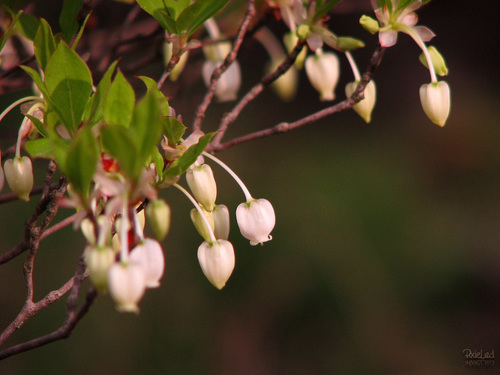
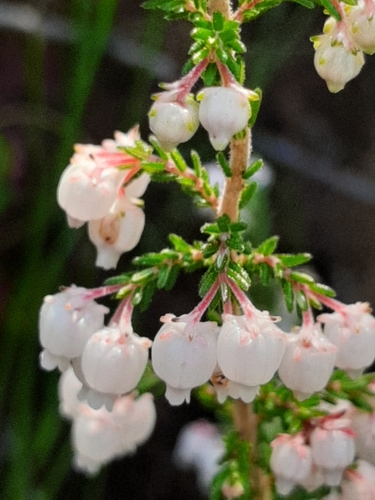
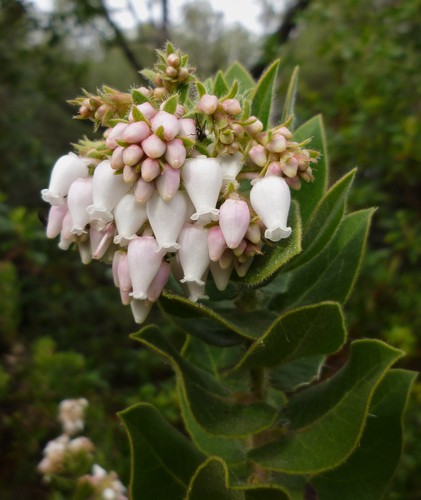
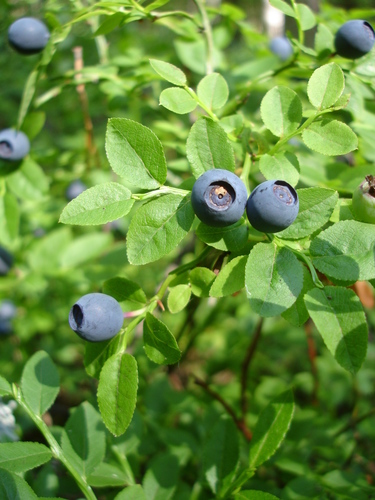
Vaccinium myrtillus L. is a small deciduous shrub that grows 10 to 51 centimetres (4 to 20 inches) tall. It is heavily branched, with upright, angular to narrow winged, glabrous green branches. It grows rhizomes that allow it to form large extensive patches. Individual shrubs can live up to 30 years, with roots reaching depths of up to 1 metre (3+1⁄2 ft). Its leaves are light green, simple, and arranged alternately along branches; they turn red in the autumn, and the plant drops all foliage in winter. Leaves are 1–3 cm (3⁄8–1+1⁄8 in) long, shaped ovate to lanceolate or broadly elliptic, with glandular to finely toothed margins, and prominent veins on their lower surface. Small hermaphrodite flowers, around 2–3 millimetres (1⁄16–1⁄8 inch) long, grow individually from leaf axils and nod downward. These flowers bloom from April to May, and have 4 to 6 mm long greenish to reddish crowns. The small calyx is fused, with minimal lobes on the cup-shaped bloom. Petals are rounded, urn-shaped, and range from white to pink, with short curved lobes. There are 8–10 short stamens, with awned, horned anthers. The ovary is inferior, has four or five chambers, and is topped with a long style. From July to September, the plant produces black-blue, flattened, round fruits that reach up to 1 cm in diameter. These multi-seeded berries have calyx remnants on the tip and a blue-gray frosted appearance. Rare variant forms of this species produce white, yellow, red, or reddish-spotted berries instead of the typical dark blue. The small, brownish seeds are crescent-shaped. Unlike Vaccinium corymbosum, the anthocyanins that give this species its fruit color are found in both the peel and the flesh. The fruit of this species persists for an average of 16.7 days, with an average of 25.3 seeds per fruit. Fruits average 85.4% water by content; their dry weight is made of 31.1% carbohydrates and 2.7% lipids. The chromosome count for this species is 2n=24. Vaccinium myrtillus is a Holarctic species native to nearly every country in Europe, north and central Asia, Japan, Greenland, Western Canada, and the Western United States. Within Europe, it is only absent from Sardinia, Sicily, the European portion of Turkey, Crete, the Aegean Islands, Cyprus, Crimea, and southern European Russia. It grows on acidic soils in heaths, boggy barrens, moorlands, degraded meadows, open forests at the base of pine and mountain spruce forests, parklands, slopes, and moraines, at elevations up to 2,350 m (7,710 ft). Consuming the leaves of Vaccinium myrtillus may be unsafe.