About Vaccinium membranaceum Douglas ex Hook.
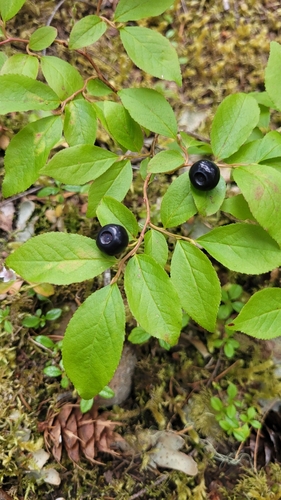
Vaccinium membranaceum Douglas ex Hook. is an erect shrub that reaches a maximum height of 1.5 metres (5 ft). Its new twigs are yellow-green and somewhat angled. It produces deciduous leaves that are alternately arranged along stems. Leaf blades are oval, very thin to membranous, and grow up to 5 centimetres (2 in) long. Leaf edges are serrated, with each tiny tooth ending in a glandular hair. Solitary flowers grow from leaf axils. Each flower is around 6 millimetres (1⁄4 in) long, urn-shaped to cylindrical, and ranges in color from pale pink to waxy bronze. The species has a cytology count of 2n = 48, and its flowers are pollinated by bees. The mature fruit is a berry around 1 cm wide, with color ranging from red through bluish-purple to a dark, almost black. Each fruit contains an average of 47 tiny seeds. The plant rarely reproduces via seed, and most often spreads by cloning itself from rhizomes or shoots. Seeds can germinate if dispersed by animals, which is confirmed by populations growing on recovering terrain at Mount St. Helens. Outside of the 2008 study by Yang et al., reports of V. membranaceum sprouting from seed are quite rare; other scientists studying this species observed only 6 seedlings during 18 years of field work. Vaccinium membranaceum is native to western North America. Its range extends from southern Alaska, Yukon, and Northwest Territories in the north, south as far as Utah and the northern mountains of California. In the west it grows from mountains adjacent to the Pacific Ocean, east to the Rocky Mountains and Black Hills. Isolated populations of this species have been recorded in Arizona, North Dakota, Minnesota, the Upper Peninsula of Michigan, and Ontario. This species grows at higher elevations in subalpine and alpine environments. It occurs in both pine- and spruce-dominated forests, as well as in open meadow ecosystems. In forests, V. membranaceum often dominates the forest understory during early to mid stages of succession. V. membranaceum is fire adapted. Its leaves and stems are resistant to low-intensity fires, and if above-ground growth is burned away, it will resprout vigorously from rhizomes buried under the soil. The plant is a key food source for black and grizzly bears, which eat its leaves, stems, roots, and fruit. Elk, moose, and white-tailed deer also browse the plant. Its dense thickets provide cover for many species of small animals. The berry of V. membranaceum is edible. It is the most commonly collected species of all wild western huckleberries, and has great commercial importance. In a productive year, V. membranaceum shrubs produce large amounts of fruit from late summer to early fall.