About Vaccinium deliciosum Piper
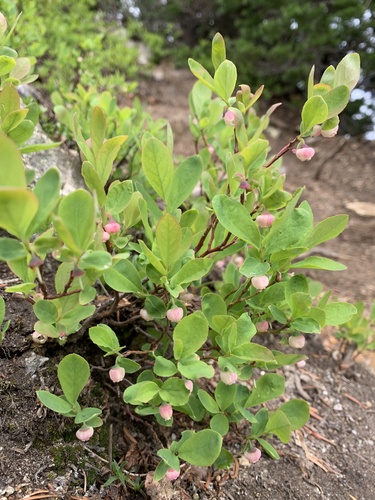
Vaccinium deliciosum Piper is a rhizomatous shrub that grows in a clumpy, matted form. Its tangled stems root where their nodes touch moist substrate, and it can form large, expansive colonies. The plant produces new green twigs that are hairless and waxy, and its deciduous leaves grow in an alternate arrangement. Its thin, oval leaf blades range from 1.5 to 5 centimeters in length; the leaf edges are mostly smooth, but may be serrated near the tips. Solitary flowers grow from leaf axils. Each flower is 6 to 7 millimeters long, widely urn-shaped to rounded, and pale pink. The fruit is a waxy blue or reddish berry with a powdery coating, which can reach more than one centimeter (over 0.4 inches) across, and is reported to be particularly tasty. This species is sometimes confused with Vaccinium caespitosum, which grows in wetter areas within the same region. Unlike V. caespitosum, V. deliciosum has a powdery coating on the underside of its leaves. Vaccinium deliciosum is native to western North America, ranging from British Columbia to northern California, with a small number of isolated populations in eastern Idaho. It grows at elevations between 600 and 2,000 meters (2,000 to 6,600 feet) in subalpine and alpine climates. Its native habitats include coniferous forests, meadows, and clearings. The berries of this shrub are an important food source in subalpine zones, especially in alpine communities that have few other edible plants. Animals that feed on the berries include black bears, birds, mice, and chipmunks, while rabbits and deer eat the plant's foliage. The berries were a staple food for Native Americans of the Columbia Plateau region, who often traveled long distances to harvest the fruit. Some tribes carried out prescribed burns to create more favorable growing habitats for the plant. After both natural and prescribed forest fires in alpine communities, V. deliciosum is often one of the most successfully surviving plant species. Because the shrub is rhizomatous, it is sometimes possible to transplant it and cultivate its cuttings for agricultural or landscaping uses. However, V. deliciosum often struggles to grow at elevations below 2,000 feet. The sweet berries are edible, and can be eaten fresh, dried, or cooked in a variety of dishes.