About Vaccinium corymbosum L.
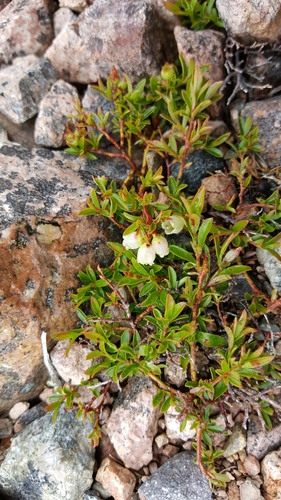
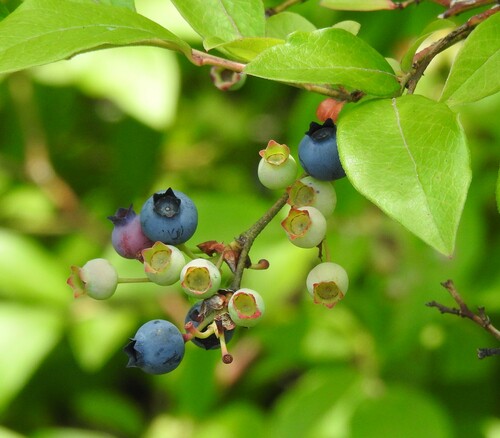
Vaccinium corymbosum L., commonly known as northern highbush blueberry, is a deciduous shrub that reaches 1.8 to 3.7 metres (6 to 12 feet) in both height and width. It frequently grows in dense thickets. Its leaves are elliptical, dark and glossy green, and can grow up to 5 centimetres (2 inches) long. In autumn, the leaves turn brilliant shades of red, orange, yellow, and/or purple. The species produces long, bell- or urn-shaped flowers that are white to very light pink, and measure 8.5 mm (1⁄3 inch) long. Its fruit is a blue-black berry with a diameter between 6.4 and 12.7 mm (1⁄4 to 1⁄2 inch). This species is tetraploid with a cytology of 2n = 48, and it cannot self-pollinate. Most cultivated cultivars need more than 800 hours of chilling to grow properly. This plant is native to eastern Canada, as well as the eastern and southern United States, ranging from Ontario east to Nova Scotia, and south to Florida and eastern Texas. It has also become naturalized in other regions across the world, including Europe, Japan, New Zealand, and the North American Pacific Northwest. It naturally grows in wooded or open habitats that have moist acidic soils. In its natural habitats, the berries of Vaccinium corymbosum act as a food source for native and migrating birds, bears, and small mammals, while deer and rabbits browse its foliage. Historically, Native American groups collected the berries for use in their cuisine across the native range of this species. Archeological evidence shows that many wild Vaccinium species were cultivated by Native Americans over thousands of years, with intentional controlled burning of crop areas in northeastern North America. Vaccinium corymbosum was one of the species likely used and managed by these groups; it was later studied and domesticated in 1908 by Elizabeth Coleman White and Frederick Vernon Coville. After domestication, it became the most common blueberry grown commercially in North America. It is also cultivated as an ornamental plant for home gardens, wildlife gardens, and natural landscaping projects. It requires very acidic soil with a pH between 4.5 and 5.5 to grow successfully.