About Uvularia grandiflora Sm.
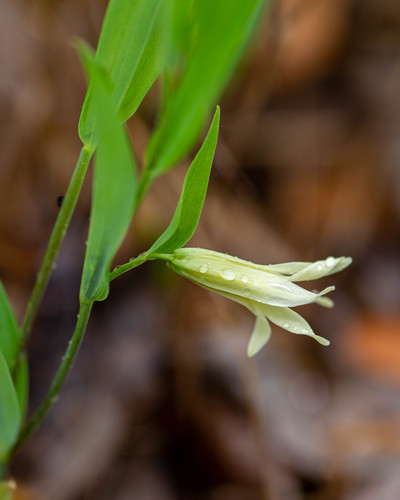
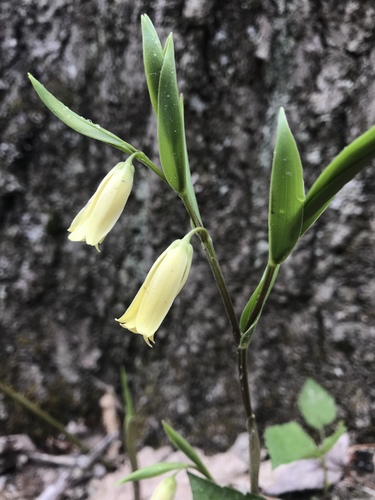
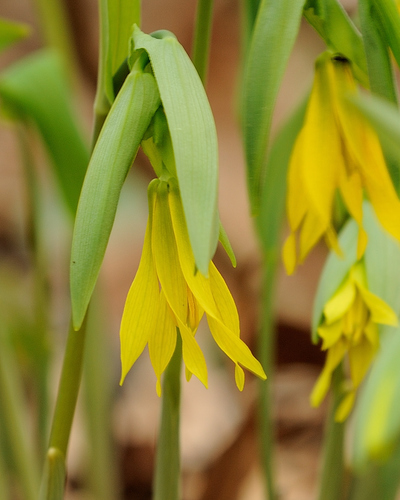
Uvularia grandiflora Sm. is a rhizomatous herbaceous perennial that grows 75 cm (30 in) tall and 30 cm (12 in) wide. It has pendent leaves that are hairy on their undersides. It blooms from mid- to late spring, producing large yellow, bell-shaped, pendent flowers that grow either solitary or in pairs. Upper portions of the plant tend to bend downward under the weight of its leaves and flowers. Its light green stems are round, glabrous, and glaucous. Its leaves are perfoliate, meaning the stem appears to grow through the base of each leaf. In late summer, its three capsuled ovaries split open to release seeds. The Latin specific epithet grandiflora translates to "large flowered". This species differs from Uvularia sessilifolia, which has smaller flowers and leaves that emerge directly from the stem rather than being perfoliate. It can also be distinguished from the eastern North American species Uvularia perfoliata; while U. perfoliata shares similar large perfoliate leaves with Uvularia grandiflora, its flower petals have orange-colored bumps. The native range of Uvularia grandiflora stretches from the Appalachians west to the Dakotas, Kansas, and Oklahoma. Its southern boundary reaches Louisiana and Georgia, while its northern extent extends into Manitoba, Ontario, and Quebec in Canada. It is widespread across the eastern mountains, the Great Lakes region, and the Mississippi Valley, with additional isolated populations along Chesapeake Bay in Maryland. Uvularia grandiflora is a woodland species that grows in open shade within rich moist woods, in soils ranging from calcareous to neutral. Bumblebees, mason bees, halictid bees, and andrenid bees feed on its nectar and collect pollen from its flowers. Deer favor eating these plants. Its seeds have attached food bodies called elaiosomes that are attractive to ants, which collect and redistribute the seeds. In cultivation in the United Kingdom, Uvularia grandiflora has been awarded the Royal Horticultural Society's Award of Garden Merit. There is one known cultivar, 'Pallida', which produces paler colored flowers.