About Utricularia dichotoma Labill.
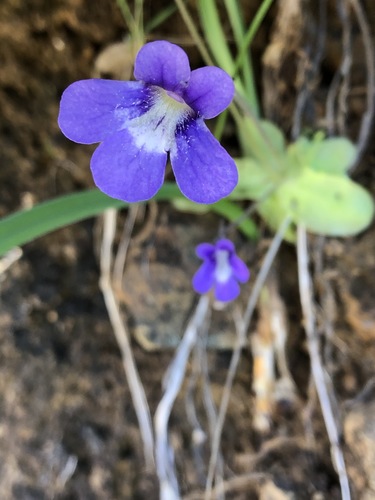
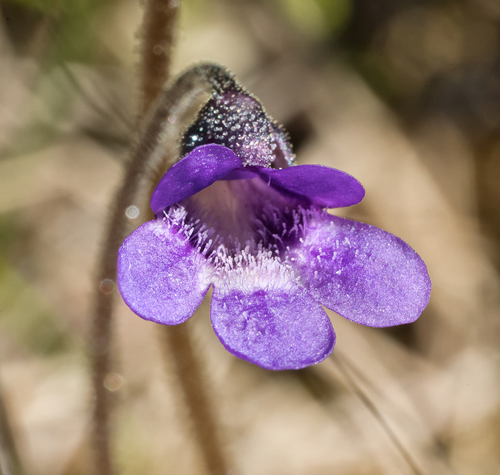
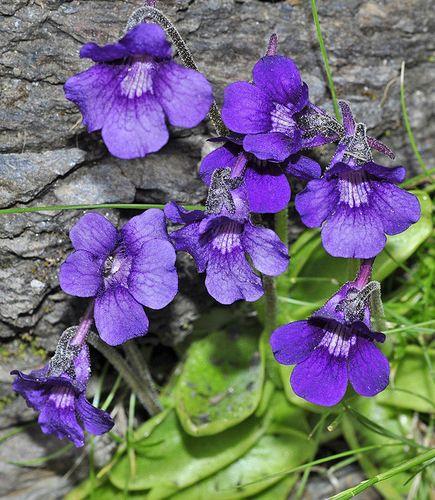
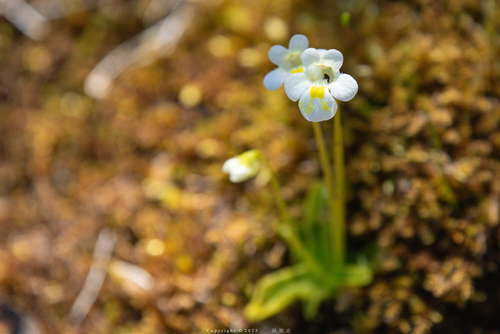
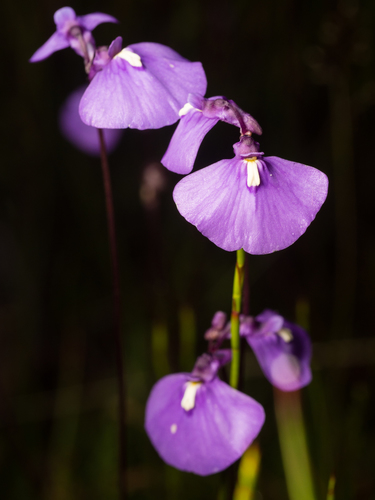
Utricularia dichotoma Labill. is a perennial carnivorous herb that produces numerous underground trailing stems, each bearing bladders 1.5–2 mm (0.06–0.08 in) in diameter. Leaves on this species are either absent, or present as a small number of oval, spoon-shaped to narrow-lanceolate structures. Present leaves come in two size forms: 2–4 mm (0.08–0.16 in) long, and up to 40 mm (1.6 in) long. The shorter form is more typical for plants growing in wet soil, while the longer form is more common in plants that grow fully submerged. Flowers are carried on a slender, wiry flowering stem that grows 5–50 cm (2.0–19.7 in) long. Flowers are arranged as solitary blooms, paired blooms, or whorls of three or four in clusters near the tip of the stem. The flowers are mauve or purple, with a small upper petal and a broader, semicircular lower lip that is 1–2 cm (0.4–0.8 in) wide. The lower lip has two or three prominent white or yellow markings, and the full corolla is 12–22 mm (0.5–0.9 in) long. Flowering occurs between August and April, and the fruit produced is a globular capsule up to 4 mm (0.16 in) wide. This species, commonly called fairy apron, is native to New Caledonia, New Zealand and Australia. In New Zealand, it grows on the North Island, South Island, and Stewart Island / Rakiura; Stewart Island / Rakiura is the most southerly location where any member of the genus Utricularia occurs. In Australia, it can be found in all states, though the majority of its occurrences are in New South Wales, Victoria and Tasmania. It grows in moist and wet locations.