About Ustilago avenae (Pers.) Rostr.
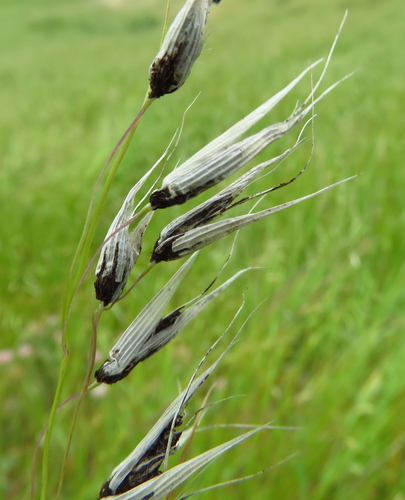
Ustilago avenae (Pers.) Rostr. is a plant pathogen that causes semiloose smut in oats. This disease appears wherever oats are cultivated, since oat seeds are rarely treated with seed treatments. Treatment levels are low because oats have a lower market price than other cereals, so seed treatment is considered uneconomical. Unlike loose smut that affects wheat and barley, semiloose smut of oats can infect up to 80 percent of an oat crop. Similar to loose smut in wheat and barley, the grains of oat plants infected with semiloose smut are completely replaced by the smut fungus. Symptoms are not visible until oat heads emerge, and the disease is very difficult to distinguish from covered smut. The life cycle of Ustilago avenae follows the same general pattern as loose smut of wheat and barley, with one key difference: the semiloose smut fungus is carried on the surface of the seed, rather than inside the seed embryo. The pathogen becomes active when the infected seed germinates, and grows toward the plant's growing point. Symptoms become visible starting at flowering, when the plant forms its head. The fungus invades all young head tissue except for the rachis, the central backbone of the head. The fungus produces plant growth hormones that cause infected plant heads to reach flowering earlier than healthy heads. The head of an infected plant develops black spore masses instead of grain. These spores are held loosely and are easily spread by wind to nearby healthy plants. Because infected heads flower earlier than healthy heads, spores are produced and released at the same time that the rest of the crop is flowering. Wind carries spores into the flowers of healthy plants. The spores enter the plant ovaries and become incorporated into the developing grain, contaminating the seed that will be grown the following year.