About Urticina piscivora (Sebens & Laakso, 1978)
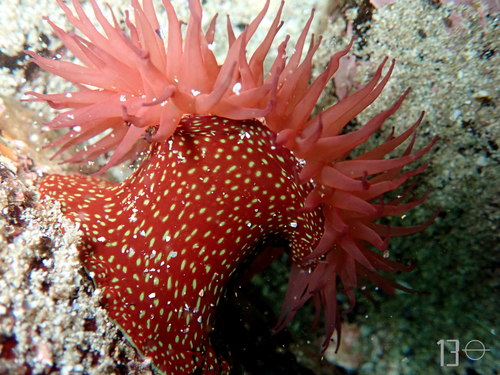
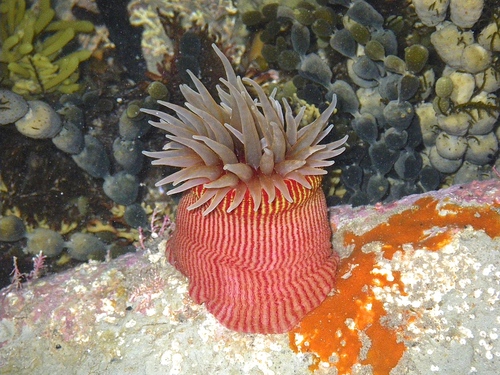
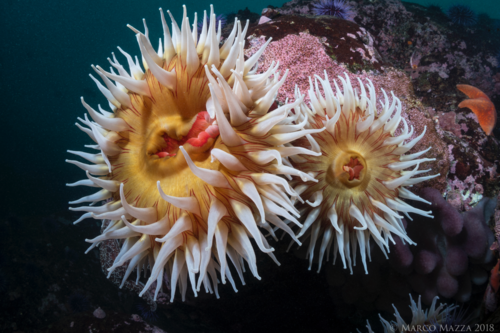
Urticina piscivora is a large sea anemone, reaching a maximum height of around 20 cm (8 in) and diameter of 10 cm (4 in). Its column is bright red. It lacks acontia (thread-like defense tissues made of stinging cells), but has non-white tubercles arranged in circumferential rows. These tubercles do not typically accumulate debris like shells and sand. This anemone’s body is made of three cell layers: the outermost epidermis, the middle mesoglea, and the innermost gastrodermis that lines the gastrovascular cavity, which functions as the anemone’s gut. The gut is divided into compartments by tissue sheets called septa, which develop into the anemone’s surface tentacles. While tentacles in most anemone species occur in multiples of six, U. piscivora notably lacks the defensive acontia many other anemones have. This species is often mistaken for Urticina crassicornis. While both can have a red column, U. crassicornis tentacles usually have transverse bands, and olive green blotches are commonly found on its column.
This species is distributed along the Pacific coast of North America, ranging from Alaska in the north down to La Jolla, California in the south. Though it can occur in intertidal zones, it most commonly inhabits exposed, rocky subtidal areas of outer coastlines. It attaches to rocky outcroppings in locations with strong currents.
Unlike many anemone species that are monoecious (each individual has both male and female reproductive organs), U. piscivora is dioecious, with separate male and female individual organisms. It reproduces sexually via external fertilization of eggs by sperm. The resulting larvae float in the current until they settle, then attach to the seabed and develop a pedal disk, which grows into a mature anemone.