About Urticina crassicornis (Müller, 1776)
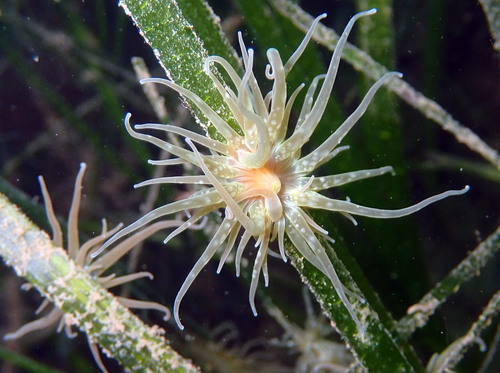
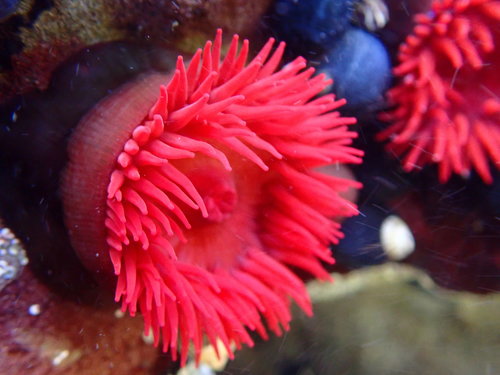
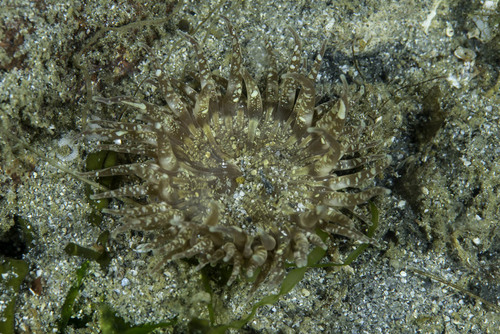
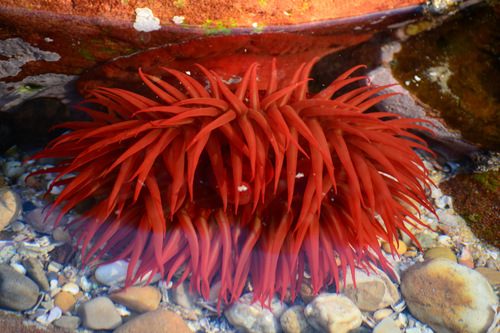
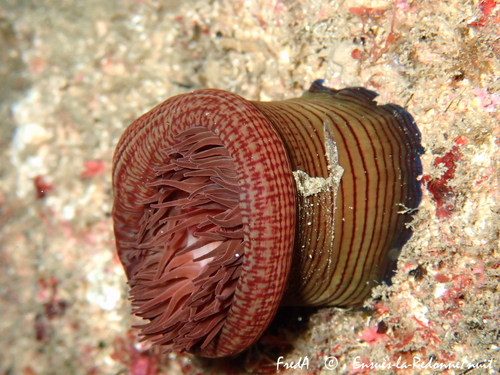
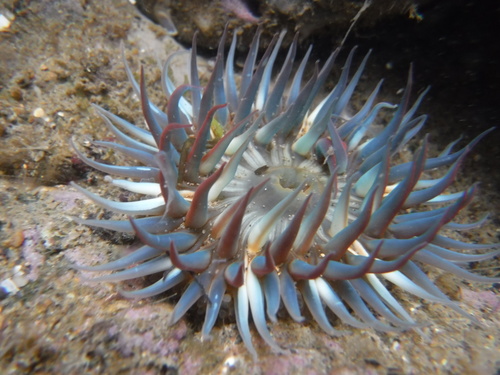
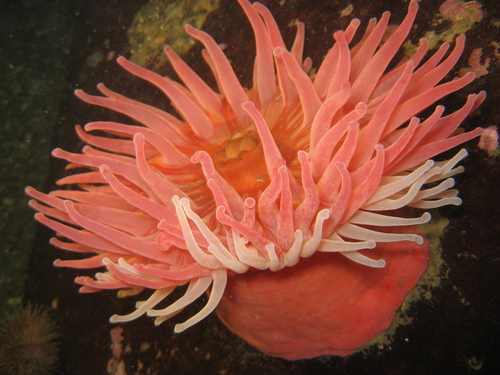
Urticina crassicornis is a species of sea anemone that is biradially symmetrical. Individuals grow 2 to 12.7 cm tall and 1 to 7.6 cm wide. They have a solid, permanently flat basal plate. Their column can be solid red, olive green with or without red spots, cream, or brown. Small, inconspicuous non-white tubercles are always present, but acontia are absent. The tubercles do not usually accumulate bits of sand, gravel, or shell. The tentacles sit above the column, are typically around 100 in number, and range from green to opaque cream with red and white striations; they are semi-transparent when extended. The tentacles are thick, conical, and blunt, arranged in 3 to 5 circular rings around the oral disc. The oral disc has no white striations, and its color usually matches that of the tentacles. Urticina crassicornis occurs in the north Pacific Ocean along the coasts of both Asia and North America, the north Atlantic Ocean along the coasts of North America and Europe, and the Arctic Ocean along the coasts of Asia, Europe, and North America. In the northeastern Pacific Ocean, its range spans the intertidal and subtidal zones from the Pribilof Islands, Alaska, to Monterey, California. In the Atlantic Ocean, it inhabits intertidal and subtidal zones from the Arctic Ocean above Newfoundland, Canada, to Cape Cod, Massachusetts, USA, and also occurs along the coasts of northwestern Europe. In the U.S. state of Washington, this sea anemone occurs more commonly in Puget Sound than along the Pacific Ocean front. It inhabits the lower intertidal to upper subtidal zone down to 30 meters deep, living in well protected, shaded areas. It is a benthic, sessile organism that attaches firmly only to hard substrata, and is frequently found on docks, wood pilings, and under large rock outcroppings. Urticina crassicornis reproduces through both asexual and sexual reproduction. In Atlantic populations, eggs and sperm are retained and fertilization takes place inside the body column. Young anemones are brooded between the body's mesenteries and released as small, well-developed individuals. Among Puget Sound populations, spawning occurs in spring; yolky eggs 0.7 mm in diameter and sperm are released into the sea for external fertilization. The major sperm chromosomal proteins of Urticina crassicornis are two specialized histone H1 proteins, which show a close relationship to the chromosomal proteins of birds and amphibians. After fertilization, superficial cleavage produces a solid, ciliated blastula. Six days after fertilization, a cone-shaped benthic larval planula develops. These planulae settle onto small rocks or the empty tubes of some annelid worms and rapidly develop into small anemones. 12 days after settlement, 8 tentacles have formed. Further growth is slow: two months after settlement, 12 tentacles appear and the anemone reaches 0.88 mm in diameter; one year after settlement, the anemone has 35 tentacles and measures 10 mm in diameter. Growth rate is proportional to food intake, not age. When starved, this anemone can survive for 9 months without growing. Urticina crassicornis reaches sexual maturity when it is 10 to 15 mm in diameter, and at that point it is at least one year old.