About Urtica dioica L.
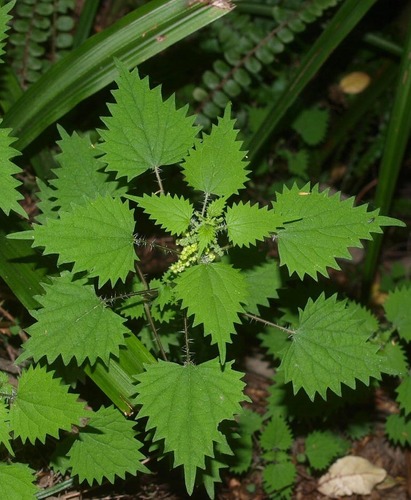
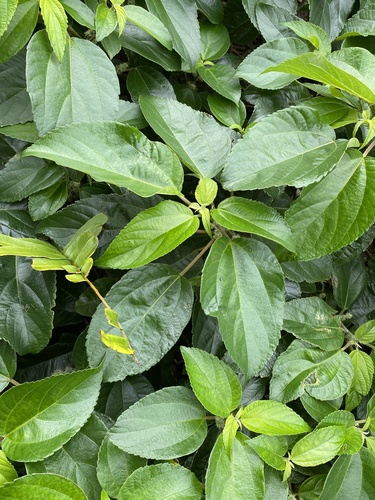
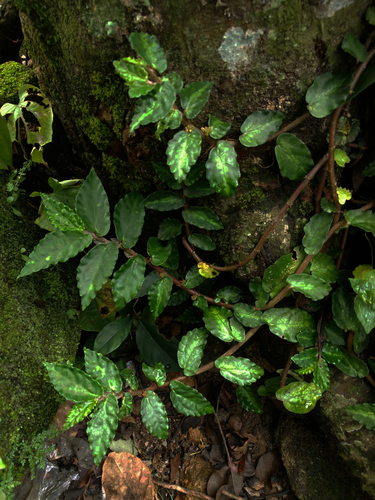
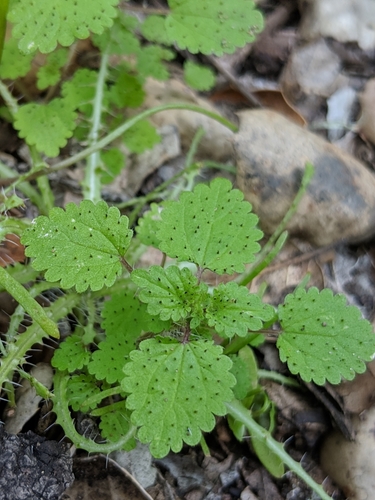
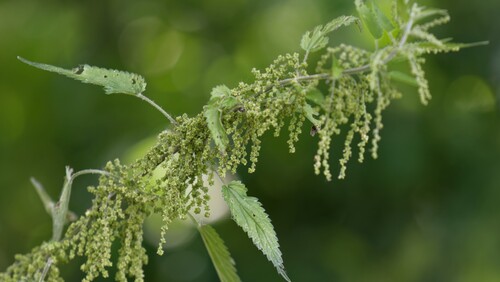
Urtica dioica L. is a dioecious, herbaceous perennial plant. It reaches 0.9 to 2 metres (3 to 7 feet) in height over the summer, and dies back to ground level during winter. It has widely spreading bright yellow rhizomes and stolons, which share this yellow color with its roots. Its soft green leaves measure 3 to 20 centimetres (1 to 8 in) long, and grow oppositely on an erect, wiry green stem. Leaves have strongly serrated margins, a cordate base, and an acuminate tip, with the terminal leaf tooth longer than the adjacent lateral teeth. The plant produces many small greenish or brownish flowers arranged in dense axillary inflorescences. Both leaves and stems are covered in many non-stinging hairs, and most subspecies also produce large numbers of stinging hairs (called trichomes or spicules). When touched, the tip of these stinging hairs breaks off, turning the hair into a needle that injects several chemicals that cause a painful sting or paresthesia. This characteristic gives the species its common names: stinging nettle, burn-nettle, burn-weed, and burn-hazel.
U. dioica is native to Europe, most of temperate Asia, and western North Africa. It grows abundantly across northern Europe and much of Asia, most often in rural countryside. It is less widespread across southern Europe and northern Africa, where its requirement for moist soil limits its range, though it is still common there. The species has been introduced to many other regions worldwide. In North America, it is widely distributed across Canada and the United States, occurring in every province and U.S. state except Hawaii, and can also be found in the northernmost part of Mexico. It grows particularly abundantly in the Pacific Northwest, especially in areas with high annual rainfall. The European subspecies of U. dioica has been introduced to Australia, North America, and South America. Within Europe, stinging nettles are strongly associated with human habitation and buildings; their presence can indicate the site of a long-abandoned building, and also signals fertile soil. Elevated levels of phosphate and nitrogen from human and animal waste create the ideal growing environment for nettles.
Stinging nettles serve as a larval food source for several butterfly species in the Nymphalidae family, including the peacock butterfly, comma (Polygonia c-album), and small tortoiseshell. They are also eaten by the larvae of a number of moth species, including angle shades, buff ermine, dot moth, the flame, the gothic, grey chi, grey pug, lesser broad-bordered yellow underwing, mouse moth, setaceous Hebrew character, and small angle shades. The roots are sometimes eaten by ghost moth (Hepialus humuli) larvae. U. dioica is a known host for the pathogenic fungus Phoma herbarum. Stinging nettle occurs most often as an understory plant in wetter environments, but can also be found growing in meadows. While the plant is nutritious, it is not commonly eaten by wildlife or livestock, likely due to its stinging hairs. It spreads via large numbers of seeds as well as rhizomes, and is often able to survive and quickly re-establish after fire.
Under its Old English name stiðe, nettle is one of the nine plants named in the pagan Anglo-Saxon Nine Herbs Charm, a 10th-century record of traditional medicine. Nettle was historically believed to be a galactagogue, a substance that promotes lactation. Urtication, the practice of flogging with nettles, involves deliberately applying stinging nettles to the skin to trigger inflammation. Used this way, the plant was considered a rubefacient (a substance that causes skin redness), and used as a folk remedy to treat rheumatism. A 2000 study found that nettles are an effective therapy for relieving arthritis pain.
In the European Union, nettle extract can be used as an insecticide, fungicide, and acaricide under Basic Substance regulations. As an insecticide, it is used to control codling moth, diamondback moth, and spider mites. As a fungicide, it is used to control Pythium root rot, powdery mildew, early blight, late blight, Septoria blight, Alternaria leaf spot, and grey mould.