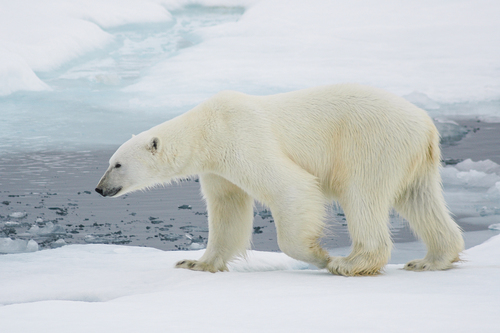
About Ursus maritimus Phipps, 1774
The polar bear (Ursus maritimus Phipps, 1774) is the largest living bear species and the largest living land carnivore, though some brown bear subspecies such as the Kodiak bear can match it in size. Adult males are typically 200–250 cm (6.6–8.2 ft) long and weigh 300–800 kg (660–1,760 lb), while females are smaller at 180–200 cm (5.9–6.6 ft) long and 150–300 kg (330–660 lb) in weight. This species has particularly high sexual dimorphism compared to most other mammals, and males also have proportionally larger heads than females. Polar bear body weight fluctuates through the year: they can bulk up on fat to increase their body mass by 50 percent, and a fattened pregnant female can reach up to 500 kg (1,100 lb). Adults measure 130–160 cm (4.3–5.2 ft) tall at the shoulder, with a 76–126 mm (3.0–5.0 in) long tail. The largest recorded polar bear was a 1,002 kg (2,209 lb) male shot at Kotzebue Sound in northwestern Alaska in 1960. Compared to the brown bear, the polar bear has a more slender build, with a narrower, flatter, smaller skull, a longer neck, and a less prominent shoulder hump. Its curved snout profile resembles a "Roman nose". Polar bears have 34–42 teeth: 12 incisors, 4 canines, 8–16 premolars, and 10 molars. Their teeth are adapted for a more carnivorous diet than that of brown bears: the canines are longer, sharper, and more widely spaced, while the cheek teeth (premolars and molars) are smaller and more pointed. There is a large gap, called a diastema, between the canines and cheek teeth that may help the bear bite more effectively into prey. Because polar bears normally hunt much smaller prey, they do not have an especially strong bite. Polar bears have large paws, with broader front paws than hind paws. Their feet are hairier than the feet of other bear species, which provides warmth and increases friction when walking on snow and sea ice. Their claws are small but sharp and hooked, used to seize prey and climb onto ice. The polar bear coat is made of a dense underfur around 5 cm (2.0 in) long, plus outer guard hairs around 15 cm (5.9 in) long. Males have longer hairs on their forelegs, which is thought to signal fitness to females. The outer surface of the hairs has a scaly texture, and the guard hairs are hollow, which lets the bears trap body heat and helps them float in water. Transparent guard hairs forward scatter ultraviolet light between the underfur and the polar bear's black skin, creating a cycle of absorption and re-emission that retains heat. The fur appears white due to backscatter of incoming light and a lack of pigment, and it develops a yellowish tint with more sun exposure, which reverses after moulting; fur may also be grayish or brownish. The light fur provides camouflage in the snowy Arctic environment. When polar bears leave the water, they can easily shake themselves dry because their hairs do not tangle easily when wet, and oil secretions keep the hairs from freezing. The polar bear's entire skin, including the nose and lips, is black to absorb heat. Under the skin, polar bears have a 5–10 cm (2.0–3.9 in) thick layer of fat that provides both insulation and energy. Polar bears maintain a core body temperature of around 36.9 °C (98.4 °F). They avoid overheating via a layer of highly vascularized striated muscle tissue and finely controlled blood vessels, and also cool down by entering water. A polar bear's eyes are positioned close to the top of its head, which lets them stay above the water surface when the bear swims. The eyes are relatively small, which may be an adaptation to protect against blowing snow and snow blindness. Polar bears are dichromats, and lack the cone cells needed to detect medium (mainly green) wavelength light. They have many rod cells, which allows good night vision. Their small ears help them retain heat and avoid frostbite. They hear best at frequencies of 11.2–22.5 kHz, a wider range than expected for a species whose prey mostly produces low-frequency sounds. The nasal concha has a large surface area that warms more air as it moves through the nasal passages. The polar bear's large olfactory system is adapted to detect prey over very long distances. They have reniculate kidneys that filter out salt from their food. Polar bears inhabit the Arctic and surrounding adjacent areas. Their range covers Greenland, Canada, Alaska (U.S.), Russia, and the Svalbard Archipelago of Norway. Individuals have been recorded as close as 25 km (16 mi) to the North Pole. The southern edge of their range includes James Bay and Newfoundland and Labrador in Canada, and St. Matthew Island and the Pribilof Islands of Alaska. They are not permanent residents of Iceland, but have been recorded visiting the island when they can reach it via sea ice. Minimal human encroachment into the species' remote habitat means polar bears still occupy most of their original range, retaining more of their historic range than any other large land carnivore. Polar bears are divided into at least 18 recognized subpopulations: East Greenland (ES), Barents Sea (BS), Kara Sea (KS), Laptev Sea (LVS), Chukchi Sea (CS), northern and southern Beaufort Sea (SBS and NBS), Viscount Melville (VM), M'Clintock Channel (MC), Gulf of Boothia (GB), Lancaster Sound (LS), Norwegian Bay (NB), Kane Basin (KB), Baffin Bay (BB), Davis Strait (DS), Foxe Basin (FB), and western and southern Hudson Bay (WHB and SHB). Bears in and around the Queen Elizabeth Islands have been proposed as an additional subpopulation, but this is not widely accepted. A 2022 study suggested that bears in southeast Greenland should be considered a separate subpopulation based on their geographic isolation and genetic differences. Polar bear populations can also be grouped into four genetic clusters: Southern Canadian, Canadian Archipelago, Western Basin (from northwestern Canada west to the Russian Far East), and Eastern Basin (from Greenland east to Siberia). Because polar bears are highly dependent on the ocean, they are classified as marine mammals. They are ice-dependent (pagophilic), and primarily inhabit annual sea ice covering continental shelves and the waters between archipelago islands. These productive regions are known as the "Arctic Ring of Life", which has high biological productivity. Polar bears tend to frequent areas where sea ice meets open water, such as polynyas and leads, to hunt seals, which make up most of their diet. Polar bears move throughout the year in response to changing ice cover, and are forced onto land in summer when seasonal sea ice melts away. Terrestrial habitats used by polar bears include forests, mountains, rocky areas, lakeshores, and creeks. In the Chukchi and Beaufort seas, where sea ice breaks off and drifts north in summer, most polar bears stay on the ice, but 15–40% of the local population has been observed spending the entire summer on land since the 1980s. Some regions have thick multiyear ice that does not melt completely, so bears can stay on the ice year-round, though this ice type supports fewer seals and has lower biological productivity. Polar bears may use annual home ranges from as small as 3,500 km2 (1,400 sq mi) to as large as 38,000 km2 (15,000 sq mi), and drifting ice allows them to travel even further. Depending on ice conditions, polar bears travel an average of 12 km (7.5 mi) per day, a feat powered by their energy-rich diet. Polar bears move by walking and galloping, and do not trot. When walking, they tilt their front paws inward toward each other. They can reach running speeds of up to 40 km/h (25 mph), but typically travel at around 5.5 km/h (3.4 mph). Polar bears are capable swimmers, reaching swimming speeds of up to 6 km/h (3.7 mph). One study found polar bears can swim for an average of 3.4 days at a time, covering an average of 154.2 km (95.8 mi). They can dive for up to three minutes. When swimming, their broad front paws do the paddling, while the hind legs are used for steering and diving. Most polar bears are active year-round; hibernation only occurs in pregnant females. Non-hibernating polar bears usually maintain a normal 24-hour activity cycle even during periods of constant darkness or constant sunlight, though shorter cycles are more common during periods of constant darkness. The species is generally diurnal, and is most active early in the day. On average, polar bears sleep close to eight hours per day. They sleep in a variety of positions: curled up, sitting up, lying on one side, lying on their back with limbs spread, or lying on their belly with the rump elevated. On sea ice, polar bears nap at pressure ridges, where they dig into the sheltered side to lie down. After a snowstorm, a polar bear may rest under the snow for hours or days. On land, bears may dig resting spots on gravel or sand beaches, and will also sleep on rocky outcrops. In coastal mountainous areas, mother polar bears and subadults sleep on slopes to better detect approaching bears. Adult males face less risk from other bears, so they can sleep almost anywhere. Polar bear mating occurs on sea ice in spring, mostly between March and May. Males search for females in estrus, and often travel along twisting paths that lower their chance of encountering other males while still allowing them to find females. Females move along linear routes and travel over wider areas. The polar bear mating system has been described as female-defence polygyny, serial monogamy, or promiscuity. When a male finds a female, he will attempt to isolate and guard her. Courtship can be somewhat aggressive, and a male will pursue a female if she tries to run away. It can take days for the male to successfully mate with the female, as mating induces ovulation. After the first copulation, the pair forms a bond. Undisturbed polar bear pairs typically stay together for around two weeks, during which they sleep together and mate multiple times. Competition for mates is intense, which has driven sexual selection for larger males. Male polar bears often have scars from fighting. When another male approaches, a bonded pair will flee together. A female may mate with multiple males in a single breeding season, and a single litter can have more than one father. After the mating season ends, females build up extra fat reserves to support themselves and their future young. Between August and October, the female digs and enters a winter maternity den. Depending on the region, maternity dens may be built in sea ice just off the coast or further inland, dug into snow, earth, or a mix of both. The inside of a maternity den is typically around 1.5 m (4 ft 11 in) wide, with a 1.2 m (3 ft 11 in) ceiling; the entrance is usually 2.1 m (6 ft 11 in) long and 1.2 m (3 ft 11 in) wide. The temperature inside the den is much warmer than the outside air. Females hibernate inside the dens and give birth to their cubs there; hibernating polar bears fast and internally recycle bodily waste. Polar bears have delayed implantation: the fertilized embryo does not begin development until fall, between mid-September and mid-October. Due to delayed implantation, total gestation lasts seven to nine months, but actual embryonic development only takes two months. Mother polar bears typically give birth to two cubs per litter. Like other bear species, newborn polar bears are tiny and altricial. Newborns have woolly hair and pink skin, and weigh around 600 g (21 oz). Their eyes remain closed for their first month of life. The cubs grow fueled by their mother's high-fat milk, and are kept warm by both the mother's body heat and the den. The mother emerges from the den between late February and early April, by which time her cubs are well-developed and able to walk alongside her. At this point, cubs weigh 10–15 kg (22–33 lb). The polar bear family stays near the den for roughly two weeks, during which the cubs move and play while the mother mostly rests, before the group travels out onto the sea ice. Cubs under one year old stay close to their mother. When the mother hunts, cubs stay still and watch until she calls them back. Watching and imitating their mother helps cubs develop their hunting skills. After their first year, cubs become more independent and explore more. By around two years old, they are able to hunt on their own. Cubs nurse while their mother is lying on her side or sitting on her rump. A lactating female cannot conceive and give birth, so cubs are weaned between two and two-and-a-half years of age. The mother may simply leave her weaned young, or the cubs may be chased away by a courting male. Polar bears reach sexual maturity at around four years old for females and six years old for males. Females reach full adult size at 4 or 5 years of age, while males finish growing at twice that age.