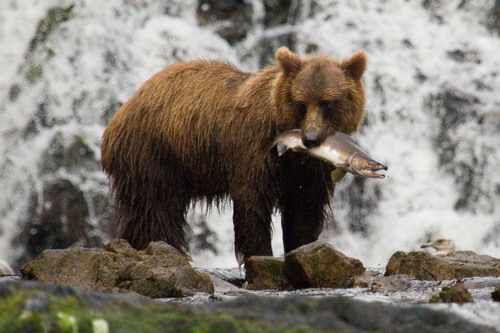
About Ursus arctos Linnaeus, 1758
Cranial morphology and size: Adult brown bears (Ursus arctos) have massive, heavily built, concave skulls that are large relative to their body size. The skull's bony projections are well developed. Among Russian brown bears, male skull lengths average 31.5 to 45.5 cm (12.4 to 17.9 in), while female skull lengths average 27.5 to 39.7 cm (10.8 to 15.6 in). Brown bears have the broadest skull of any living ursine bear. The zygomatic arch width measures 17.5 to 27.7 cm (6.9 to 10.9 in) for males, and 14.7 to 24.7 cm (5.8 to 9.7 in) for females. Brown bears have powerful jaws, with large incisors and canine teeth; lower canines are strongly curved. The first three molars of the upper jaw are underdeveloped, single-crowned, and have one root each. The second upper molar is smaller than the other upper molars, and is usually absent in adult brown bears. It is typically lost at an early age, leaving no trace of its original tooth socket (alveolus) in the jaw. The first three molars of the lower jaw are very weak, and are also often lost at an early age. Brown bear teeth reflect the species' dietary flexibility, and are broadly similar to the teeth of other bear species. They are consistently larger than the teeth of American black bears, but average smaller in molar length than the teeth of polar bears.
Distribution and habitat: Brown bears occupy the widest range of habitats of any living bear species. They have no observed altitudinal preference, and have been recorded from sea level up to 5,000 m (16,000 ft) in the Himalayas. Across most of their range, brown bears prefer semi-open terrain with scattered vegetation that provides daytime resting spots. However, they have been recorded living in every type of northern temperate forest that occurs. This species was once native to Europe, most of Asia, the Atlas Mountains of Africa, and North America, but has been completely extirpated from some areas, and populations have declined sharply in many other areas. There are approximately 200,000 brown bears remaining worldwide. The largest populations are in Russia (130,000 individuals), the United States (32,500 individuals), and Canada (around 25,000 individuals). In North America, brown bears live in Alaska, extending east through the Yukon and Northwest Territories, south through British Columbia, and across the western half of Alberta. Alaska's brown bear population is estimated at a healthy 30,000 individuals. In the contiguous lower 48 United States, populations are slowly but steadily repopulating areas along the Rockies and the western Great Plains. In Europe, 2010 counts recorded 14,000 brown bears across ten fragmented populations, ranging from the west (Spain, with an estimated 20–25 individuals in the Pyrenees in 2010 across a range shared by Spain, France, and Andorra, and around 210 individuals in Asturias, Cantabria, Galicia, and León in the Picos de Europa and adjacent areas in 2013) east to Russia, and from Sweden and Finland in the north south to Romania (5,000–6,000), Bulgaria (900–1,200), Slovakia (about 600–800), Slovenia (500–700), and Greece (around 900). In Asia, brown bears are found primarily across Russia, then more sparsely southwest into parts of the Middle East including Turkey's eastern Black Sea region (home to 5,432 brown bears), reaching as far south as southwestern Iran, and east into Northeast China. They are also found in Western China, Kyrgyzstan, North Korea, Pakistan, Afghanistan, and India. A population of brown bears lives on the Japanese island of Hokkaido, which holds the largest number of non-Russian brown bears in eastern Asia, with approximately 2,000–3,000 individuals.
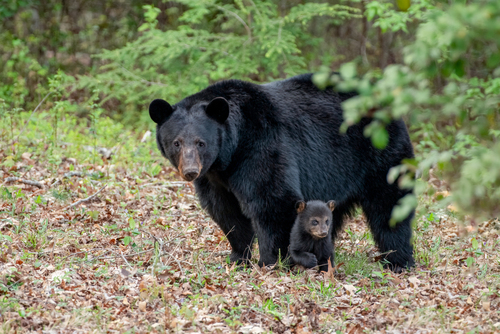
Reproduction: The brown bear mating season runs from mid-May to early July, and occurs later in the year at more northern latitudes. Brown bears are polygynandrous: individuals stay with a single mate for a few days to a couple of weeks, and mate with multiple partners over a single mating season. Outside this narrow mating window, adult male and female brown bears show no sexual interest in one another. Females reach sexual maturity between four and eight years of age. Males first mate roughly one year later, when they have grown large and strong enough to compete with other males for mating access. Males attempt to mate with as many females as possible; a successful male will usually mate with two females over a one to three week period. Similarly, adult females can mate with up to four, and sometimes even eight, males while in oestrus (heat), and may mate with two different males in a single day. Females enter oestrus every three to four years, with an overall range of 2.4 to 5.7 years between oestrus cycles. Urine markings from an oestrus female attract multiple males via scent. Dominant males may attempt to sequester a female for her full oestrus period, which lasts approximately two weeks, but they usually cannot keep her contained for the entire time. Copulation is prolonged, lasting more than 20 minutes. Males do not participate in raising cubs; all parental care is done by females. Through delayed implantation, a female's fertilized egg divides and floats freely in her uterus for six months. During winter dormancy, the fetus attaches to the uterine wall. Cubs are born eight weeks later, while the mother sleeps. If the mother does not gain enough weight to survive through the winter of gestation, the embryo does not implant and is reabsorbed into her body. Litters can have up to six cubs, though litters of one to three are more common. Litter size depends on factors including geographic location and food availability. At birth, cubs are blind, toothless, and hairless, and weigh 350 to 510 g (0.77 to 1.12 lb). There are recorded cases of females adopting stray cubs, or even trading or kidnapping cubs when they emerge from hibernation (a larger female may take cubs from a smaller one). Older, larger females in a population tend to give birth to larger litters. Cubs nurse on their mother's milk until spring or early summer, depending on climate conditions. By this point, cubs weigh 7 to 9 kg (15 to 20 lb) and are developed enough to follow their mother and forage for solid food over long distances. Cubs are dependent on their mother, and a close bond forms between them. During the dependency stage, cubs learn rather than instinctively inherit survival techniques, including which foods have the highest nutritional value and where to find them, how to hunt, fish, and defend themselves, and where to build dens. Increased brain size in large carnivores is positively linked to whether the species is solitary (as the brown bear is) or raises offspring communally. For this reason, the relatively large, well-developed brain of the female brown bear is thought to be key to teaching these survival behaviors. Cubs learn by following and imitating their mother's actions while they stay with her. In North America, cubs remain with their mother for an average of 2.5 years, gaining independence anywhere from 1.5 to 4.5 years of age. Independence is generally attained earlier in some parts of Eurasia: the latest recorded association between a mother and cubs was 2.3 years. One study in Hokkaido found most mother-cub pairs separated in under two years, and most yearlings in Sweden are independent. Brown bears practice infanticide: an adult male bear may kill the cubs of another male. When an adult male kills a cub, this is typically done to bring the cub's mother into oestrus, as a female will enter oestrus within two to four days after her cubs die. Cubs often flee up a tree when they spot an unfamiliar male approaching. The mother often successfully defends her cubs, even though the male may be twice her weight. However, females have been recorded dying in these confrontations.