About Ursus americanus Pallas, 1780
The American black bear (Ursus americanus), often called simply black bear, is a medium-sized bear species endemic to North America. It is the smallest and most widely distributed bear species on the continent. American black bears are omnivores, and their diets vary greatly based on season and location. They typically live in heavily forested areas, but will leave forests to search for food, and are sometimes drawn to human communities because food is easily available there. The International Union for Conservation of Nature (IUCN) lists the American black bear as a species of least concern, due to its widespread distribution and large total population, which is estimated to be twice the size of the combined population of all other bear species. Along with the brown bear (Ursus arctos), it is one of two modern bear species that the IUCN does not consider globally threatened with extinction.
Historically, American black bears lived across most of North America's forested regions. Today, they are mainly restricted to sparsely settled forested areas. Currently, American black bears occupy most of their original range in Canada, though they are rarely found in the southern farmlands of Alberta, Saskatchewan, and Manitoba, and have been extirpated from Prince Edward Island since 1937. Surveys conducted in the mid-1990s put Canada's black bear population between 396,000 and 476,000 across seven provinces; this estimate does not include populations in New Brunswick, the Northwest Territories, Nova Scotia, and Saskatchewan. All Canadian provinces reported stable American black bear populations throughout the 2000s.
In the United States, the species' current range remains consistent across most of the Northeast, the Appalachian Mountains almost continuously from Maine to northern Georgia, the northern Midwest, the Rocky Mountain region, the West Coast, and Alaska. In other regions of the U.S., the range is increasingly fragmented or the species is entirely absent. Even so, American black bears have expanded their range in these areas over recent decades, including new sightings in Ohio, Illinois, southern Indiana, and western Nebraska. Sightings of traveling black bears are common in the Driftless Area of southeastern Minnesota, northeastern Iowa, and southwestern Wisconsin. In 2019, biologists from the Iowa Department of Natural Resources confirmed the documentation of a year-round American black bear living in woodlands near the town of Decorah in northeastern Iowa; this is thought to be the first resident black bear in Iowa since the 1880s.
Surveys of 35 U.S. states conducted in the early 1990s found that American black bear populations were either stable or increasing, with the only exceptions being Idaho and New Mexico. In 2011, the total American black bear population in the United States was estimated to be between 339,000 and 465,000; this estimate excludes data from Alaska, Idaho, South Dakota, Texas, and Wyoming, whose populations were not included in that survey. In 2017, California had an estimated 25,000 to 35,000 black bears, the largest population of the species in any of the 48 contiguous United States. In 2020, Great Smoky Mountains National Park hosted around 1,500 bears, with a population density of approximately two bears per square mile. In western North Carolina, the black bear population has grown dramatically from around 3,000 in the early 2000s to over 8,000 in the 2020s.
As of 1993, known black bear populations in Mexico existed in four areas, and no updated information on populations outside these areas has been published since 1959. Mexico is the only country where the American black bear is classified as endangered.
Across their entire range, preferred American black bear habitats share a few common traits. They are often found in areas with relatively hard-to-access terrain, thick understory vegetation, and large amounts of edible material, especially masts. This species' adaptation to woodlands and thick vegetation may have originally developed because black bears evolved alongside larger, more aggressive bear species, such as the extinct giant short-faced bear and the grizzly bear, that took over more open habitats. Historically, larger predators including Smilodon and the American lion that could prey on black bears may also have shaped this adaptation. Although American black bears are most abundant in undisturbed wild areas and rural regions, they can adapt to survive in some numbers in peri-urban regions, as long as those areas have easily accessible food and some vegetative cover.
In most of the contiguous United States, American black bears are now typically found in heavily vegetated mountainous areas, between 400 and 3,000 m (1,300 to 9,800 ft) in elevation. For American black bears living in the American Southwest and Mexico, habitat usually consists of chaparral stands and Pinyon–juniper woodlands. In this region, bears sometimes move into more open areas to feed on prickly pear cactus. The American black bear occupies at least two distinct main habitat types in the Southeastern United States. In the southern Appalachian Mountains, American black bears live mainly in oak-hickory and mixed mesophytic forests. In the coastal areas of the Southeast, such as Florida, the Carolinas, and Louisiana, bears live in a mix of flatwoods, bays, and swampy hardwood sites.
In the northeastern part of the species' range, covering the United States and Canada, main habitat consists of a forest canopy of hardwoods including beech, maple, and birch, plus coniferous species. Corn crops and oak-hickory mast are also common food sources in some parts of the northeast; small, thick swampy areas with stands of white cedar provide excellent protective cover. Along the Pacific coast, redwood, Sitka spruce, and hemlocks are the dominant overstory cover. Within these northern forest types, early successional areas such as brush fields, wet and dry meadows, high tidelands, riparian areas, and a variety of mast-producing hardwood species are important for American black bears. Spruce-fir forest covers most of the American black bear's range in the Rockies. Important non-forested areas here include wet meadows, riparian areas, avalanche chutes, roadsides, burns, sidehill parks, and subalpine ridgetops.
In areas with relatively low human development, such as large parts of Canada and Alaska, American black bears are more regularly found in lowland regions. In parts of eastern Canada, especially Labrador, American black bears have adapted to live exclusively in semi-open areas that are more typical brown bear habitat in North America. This is likely because brown bears, polar bears, and other large carnivore species are absent from this area.
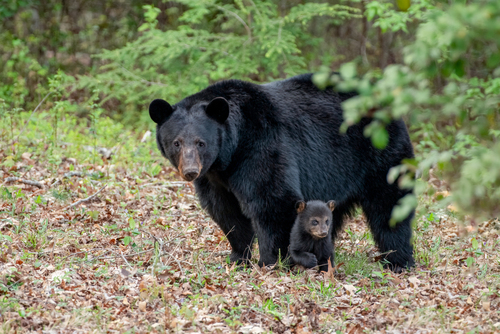
Female American black bears (sows) usually produce their first litter when they are 3 to 5 years old; individuals living in more developed areas tend to become pregnant at younger ages. Breeding usually happens between June and July, though it can extend into August in the northern part of the species' range. The breeding period lasts two to three months, and both sexes are promiscuous. Males attempt to mate with multiple females, but large dominant males may violently claim a female if another mature male approaches. Copulation can last 20 to 30 minutes, and sows are typically short-tempered with their mates after copulation. Fertilized eggs undergo delayed development, and do not implant in the female's uterus until November. The total gestation period is 235 days, and litters are usually born in late January to early February. Litter size ranges from one to six cubs, and is most often two or three. At birth, cubs weigh 280 to 450 g (0.62 to 0.99 lb) and measure 20.5 cm (8.1 in) long. They are born with fine, gray, downy hair and underdeveloped hind quarters. They typically open their eyes 28 to 40 days after birth and begin walking after 5 weeks. Cubs depend on their mother's milk for 30 weeks, and become independent at 16 to 18 months. At 6 weeks old, cubs weigh 900 g (2.0 lb), by 8 weeks they reach 2.5 kg (5.5 lb), and by 6 months they weigh 18 to 27 kg (40 to 60 lb). American black bears reach sexual maturity at 3 years old and reach full adult growth at 5 years old.