About Urosaurus ornatus (Baird & Girard, 1852)
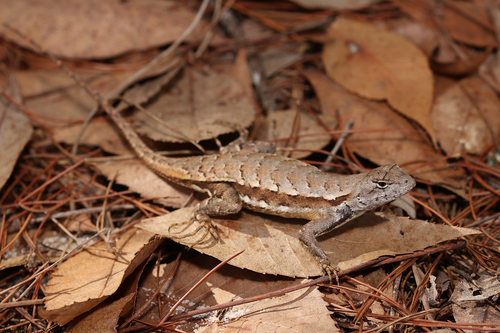
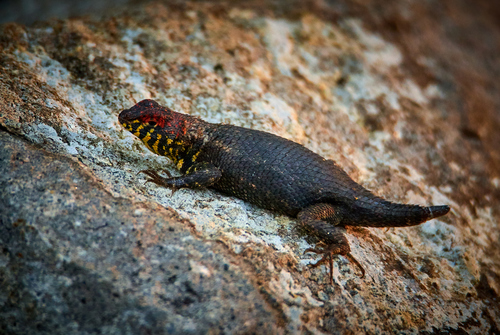
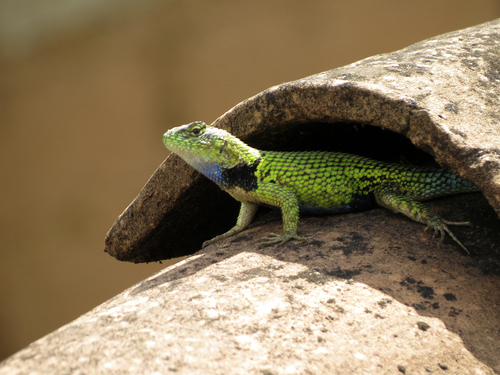
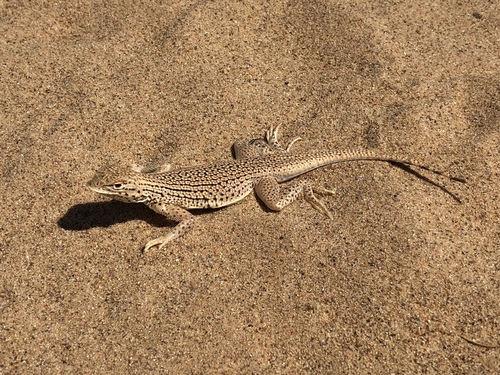
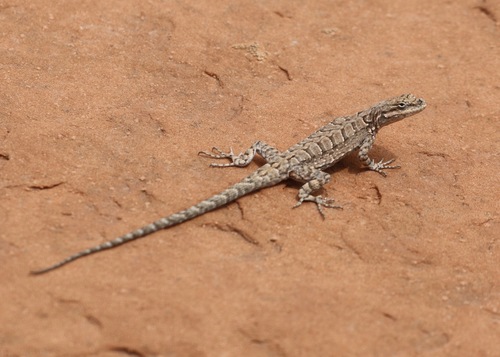
Urosaurus ornatus, commonly known as the ornate tree lizard, is a species of lizard in the family Phrynosomatidae. It is native to the southwestern United States and northwestern Mexico. Formerly called simply the "tree lizard", this species has been used to study physiological changes during the fight-or-flight response as related to stress and aggressive competition. Its life history and the costs of reproduction have been documented in field populations in New Mexico and Arizona. This species has been fairly well studied because males within a population have interesting variation in throat color that can correlate with different reproductive strategies.
As ectotherms, ornate tree lizards have a temperature-dependent lifestyle, so they may not follow the predictions of density-dependent habitat selection models, because temperature strongly influences their habitat selection and population structure. Since competition for resources can cause a decrease in fitness, increased population size should lead to reduced body size and growth rates across the entire population. For this species, population density-dependent growth occurs for females but not for males. The temperature quality of the environment that these lizards inhabit also determines their body size and body composition. Lizards that grow up in crowded spaces, poor-resource environments with lower temperatures grow smaller than lizards in higher-quality environments with suitable temperatures and abundant resources. It has been proposed that the amount of rainfall ornate tree lizards experience triggers a wide range of changes to their behaviors. From 1974 to 1978, researchers observed this lizard's behavior over a four-year study in the Grapevine Hills of Big Bend National Park, Texas. Precipitation was abundant in 1974 and 1976, while very little precipitation fell in 1975 and 1977. During dry years, available prey decreases, and ornate tree lizards have significantly lower individual foraging success, growth rates, body masses, and prehibernation lipid levels. Population density is also reduced in dry years. These results led researchers to propose that dry years act as stressors that cause changes to the diet, behaviors, and health of individual lizards. Drought causes food scarcity, which leads to increased intra-specific competition for resources. Studies have shown that Sceloporus merriami and U. ornatus also compete interspecifically for resources. Limited resources lower the population density of both lizard species. The intensity of competition between these two species varies seasonally, and this variation is highly correlated with food availability and rainfall amount. Where rainfall varies, the intensity of interspecific competition also varies, so environmental conditions directly affect competition and food availability for the ornate tree lizard.
Urosaurus ornatus is one of the most widespread and abundant lizard species in North America. It lives across a wide range of U.S. states: California, Nevada, Utah, Colorado, Wyoming, Arizona, New Mexico, and Texas. Across its wide range and varied habitats, it can be arboreal, semi-arboreal, or saxicolous. It is also found in multiple Mexican states: Sonora, Sinaloa, Chihuahua, and Coahuila. The southwestern United States has large temperature ranges, and these lizards adapt to the different climates they inhabit. Their mean body temperature changes based on their location. Male lizards have a body temperature of 35 degrees Celsius in both montane and desert habitats, but around 38 degrees Celsius in desert riparian habitats. Their body temperature differences reflect the climates they live in. These temperature differences also occur between male and female lizards: on average, female body temperature is lower than male body temperature. It has been suggested that this body temperature difference may be related to sexual differences between males and females, and could also affect clutch health and clutch size.
A U. ornatus social group consisting of one male and one or more females typically occupies an area that contains one or more large trees, shrubs, or boulders. The male copulates with each female, and females retain eggs for approximately two weeks after mating. In many parts of the species' range, females may lay more than one clutch of eggs per year. There is a direct correlation between female body size and the size of the clutch she produces: clutch size increases as body size increases, so larger females have higher fitness due to their larger size. Female body size may be a preferred trait in sexual selection when choosing mates; males may prefer larger females because they produce more offspring, which helps males pass on their genes. There is also a relationship between the environment where the clutch develops and clutch size. Females that lay eggs in wet years tend to have larger clutch sizes than females that lay eggs in dry years. This is the result of temperature-dependent reproduction and environmental effects on the reproductive process. The optimized temperature for a clutch to reach maximum size matches the temperatures associated with the dry breeding season. Reproducing female ornate tree lizards are generally gravid from late March through August. They typically produce two to seven eggs per clutch annually, but mean clutch size is variable. Clutch size varies by season and by the female's geographical location; the latitude a reproducing female inhabits changes her reproductive outcomes. All hatchlings reach sexual maturity within one year of hatching. Hatchlings emerge from mid-June through November, with the highest hatching rates occurring in autumn. Females have enlarged ovarian follicles from the beginning of March through August, and the frequency of pregnant females is highest during April, July, and August. Sexually mature male ornate tree lizards have enlarged testes from June through November. When males emerge from brumation in January, their testes are small. Mean testis size grows progressively larger through February, March, and April, levels off by April, and generally reaches its maximum size by June. By July, testis size decreases slightly, and it decreases rapidly through August and September. When resources become scarce for ornate tree lizards, the species faces a range of critical challenges. There is direct resource competition between a female's reproductive system and immune system. When food intake is experimentally manipulated in reproducing female ornate tree lizards, changes occur in how their bodies allocate resources. When females have unlimited access to food, both their reproductive and immune systems are well maintained and healthy, because these females can invest more energy into both reproduction and their immune systems. This allows these females to reproduce while also healing any wounds they have. When females follow a restrictive diet, their reproductive and immune functions change. If a reproducing female must allocate energy to both reproduction and immune function, a trade-off occurs, so these females develop smaller follicles than non-wounded females. When females are denied all access to food (extreme food restriction), they do not invest any energy into either their reproductive or immune systems. This means that female ornate tree lizards are affected by resource competition between their reproductive and immune systems, and this competition only appears when resources are limited. The intensity of this trade-off depends on resource abundance, and since resource abundance changes alongside a constantly changing environment, the intensity of the trade-off also changes. While less well-studied than male variation, female ornate tree lizards can also vary in throat coloration. When females are gravid with eggs, they tend to be orange or red. Recent experiments suggest that females have associations and possibly mating preferences for different male types, and this female preference varies based on the female's own throat color and the colors of the two males she is presented with.