About Urosalpinx cinerea (Say, 1822)
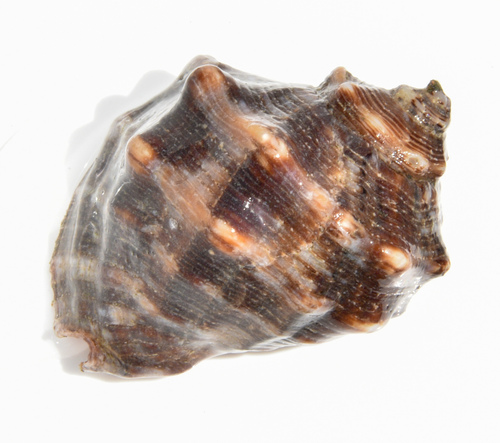
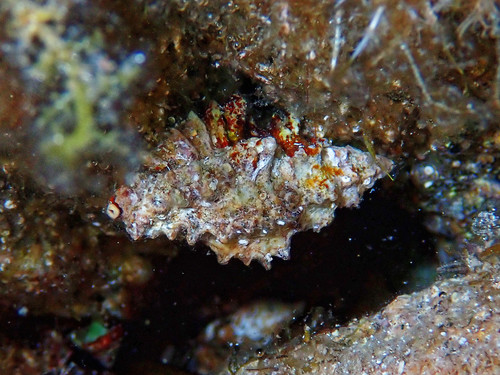
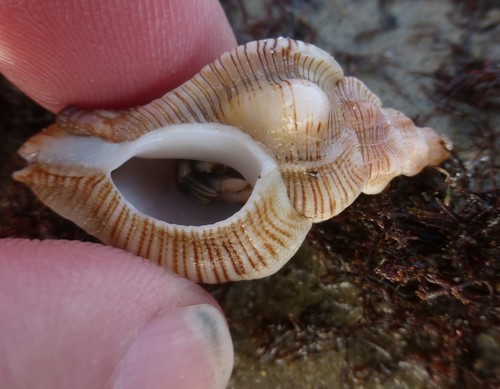
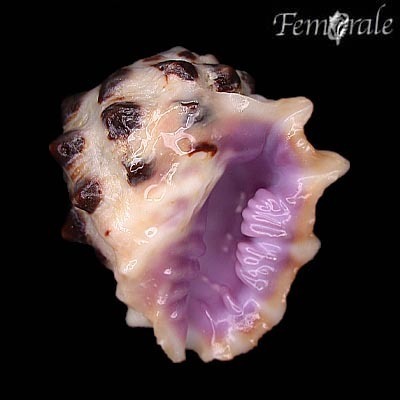
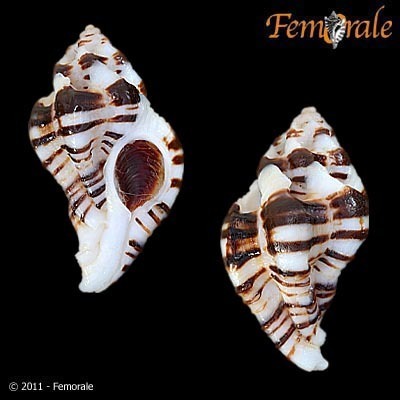
Urosalpinx cinerea (Say, 1822) typically has a light brown or yellowish shell, rarely marked with several indistinct revolving rufous bands. The interior of the aperture ranges in color from pale flesh-color to dark salmon, chocolate, or purple. The fusiform shell is solid and thick, with a sharply pointed apex. The species cannot fully seal itself off from the surrounding environment due to its open siphonal canal. The shell's sculpture features prominent broad ribs and numerous strong, rounded, wavelike longitudinal folds, with intervals shaped like reversed folds. The aperture makes up half the total length of the shell; it is long-oval, and extends downward into a short, open siphonal canal. The outer lip of the aperture is thin. This is a small animal, with a foot that barely covers the aperture, and is only slightly widened at the front angles. The foot is cream-colored, lemon-yellow along the lower margin, and dotted with light drab on the upper surface. The siphon extends only slightly past the tip of the siphonal canal. The head protrudes very little; the tentacles are almost joined at their base, with black contractile eyes positioned on the outer upper third of each tentacle, a section that is just a thin filament. The snail moves sluggishly. The eggs of Urosalpinx cinerea are held in small transparent membranous parchment-like vases. Each vase attaches to a solid surface via an expanded base, most often to the underside of an overhanging rock a short distance above low-tide mark. Each female lays between ten or twelve and over one hundred of these vases, and the egg-laying process takes several weeks. The vases are usually attached in roughly regular rows, and may sometimes cover an area of three to four square inches. They match the shape and size of Purpura egg cases, but lack the faint reddish tinge seen in Purpura cases. The vases are flattened vertically, with keel-like ridges along their edges. Because oviposition takes place over an extended period, eggs and embryos at every stage of development can be found across a single group of vases. The young hatch from the earliest laid vases before the female finishes laying all of her eggs. Unlike Purpura vases, which each hold several hundred eggs, Urosalpinx cinerea vases contain only 6 to 20 eggs, with 10 to 12 being the typical count. Almost all of these eggs develop normally into embryos. Occasionally, a partially segmented egg or more developed embryo becomes abortive and breaks apart into individual cells. Each of these cells stays alive for some time, and often swims actively by moving its cilia. These cosmelae and the yolk from aborted eggs are drawn into the digestive cavities of other embryos, but this form of nourishment for developing young is accidental and exceptional. This snail is endemic to the Atlantic coast of North America, ranging from Nova Scotia to Nassau Sound, Florida. It has been accidentally introduced along with oyster spat to Northern Europe, and to the West Coast of North America from California to Washington. It occurs in habitats where salinity and temperature change with seasons and tidal currents. The species lives from low tide down to a depth of 25 feet, in rocky areas and shell beds. It inhabits the lower third of the littoral zone, so it is sheltered from ocean waves.