About Uroplatus phantasticus (Boulenger, 1888)
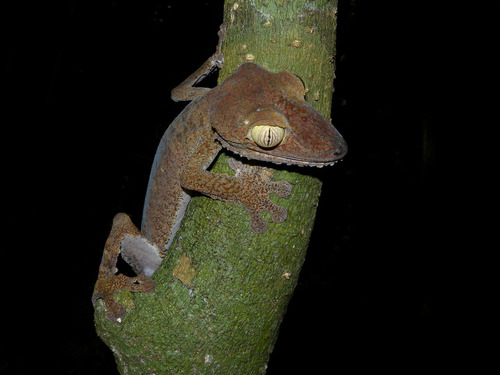
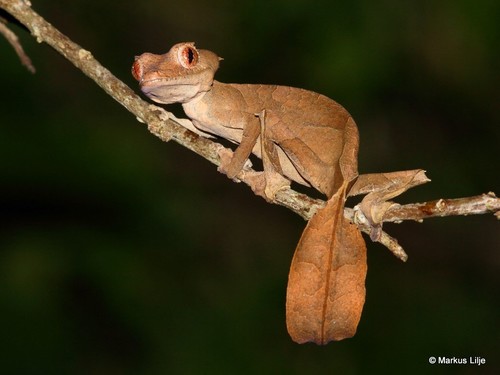
Description: Adult Uroplatus phantasticus reach a maximum total length of 90mm, including the tail. Like all Uroplatus geckos, this species has a flattened tail, but the distinct leaf-like tail shape is limited to the ebenaui complex, which includes U. phantasticus, U. ebenaui, and U. malama. U. ebenaui is an exception within this group, with a much smaller reduced tail. Researchers have long debated whether U. phantasticus is actually the same species as U. ebenaui, the Nosy Bé flat-tailed gecko. U. phantasticus can be distinguished by having more and longer spines across its head, body, and trunk. Other Uroplatus genus members have flattened tails that primarily work to reduce the gecko’s overall profile when it is inactive. Some individual U. phantasticus even have notches along their tails to create a closer mimicry of a decaying leaf. This notched tail trait is thought to be a form of sexual dimorphism, as it appears more commonly in males of the species. Additionally, U. phantasticus has an eyelash-like projection above each eye. All of these physical adaptations help the gecko blend into its surrounding environment during daylight hours, and provide camouflage that aids it when hunting for prey at night. Like all geckos, this species does not have eyelids. Instead, it has a transparent covering over each eye, and uses its long, mobile tongue to wipe away dust or debris that enters the eye. Uroplatus phantasticus comes in a range of colors, including shades of purple, orange, tan, and yellow, but individuals are most often mottled brown. The species can be told apart from similar related species by the small black dots present on its underside. Distribution and habitat: This species is endemic to Madagascar, and is not naturally found anywhere else in the world. It is an arboreal animal that depends on its natural camouflage, and inhabits the northern and central tropical forests of Madagascar.