About Urolophus paucimaculatus Dixon, 1969
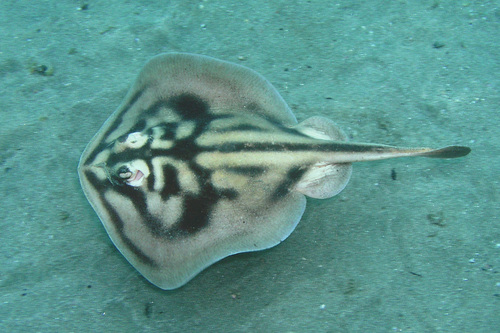
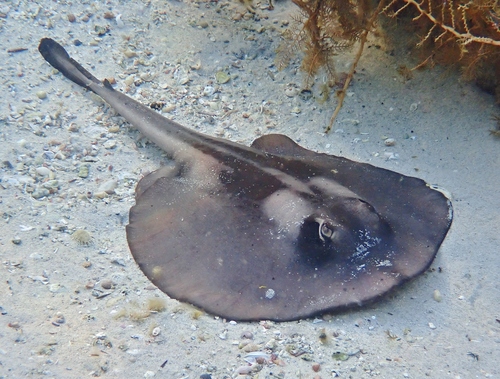
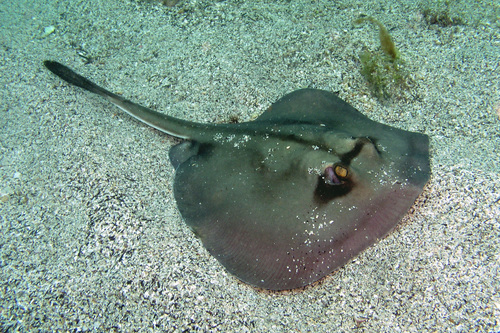
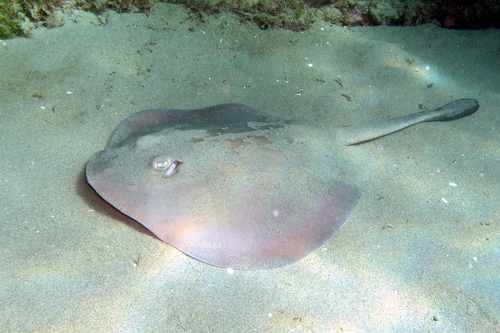
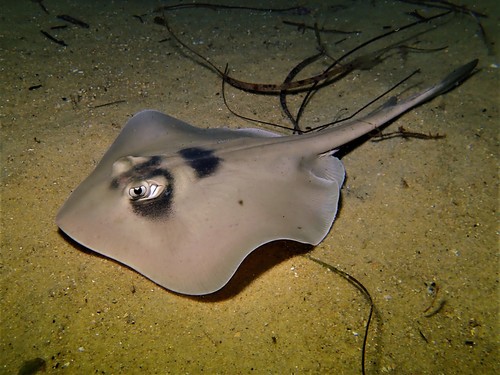
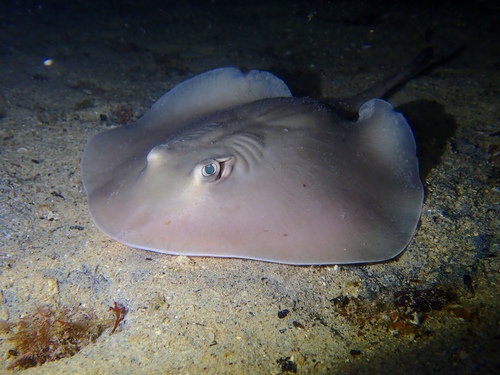
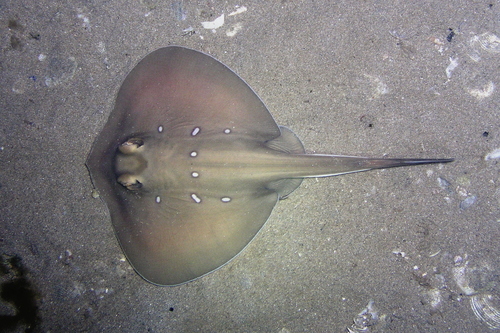
The sparsely spotted stingray (Urolophus paucimaculatus) has a roughly diamond-shaped pectoral fin disc that is wider than it is long, with rounded outer corners. The anterior disc margins are nearly straight, converging at an obtuse angle on a fleshy snout whose tip barely protrudes from the disc. Small eyes are immediately followed by comma-shaped spiracles with angular or rounded posterior rims. The outer rim of each nostril expands into a backward-facing knob. Between the nostrils sits a bell-shaped curtain of skin with a finely fringed trailing margin; only the Kapala stingaree (U. kapalensis) shares this similar nasal curtain shape. The small mouth holds five or six nipple-like papillae on its floor, most of which have forked tips, with additional small papillae on the outside of the lower jaw. Teeth in both jaws are small with roughly oval bases, arranged in a quincunx pattern. The five pairs of gill slits are short, and the pelvic fins are small and rounded. The tail is 77–98% as long as the disc; it is very flattened at the base and slender toward the tip, which holds a deep, leaf-shaped caudal fin. A prominent fold of skin runs along either side of the tail, and a serrated stinging spine sits on the upper surface about halfway along the tail’s length. There is no dorsal fin, and the skin is completely free of dermal denticles. This species is uniformly light gray on its upper surface with a darker V-shaped marking between the eyes, and white on its underside with slightly darker lateral disc margins. Most individuals from the southern part of its range also have a small number of small, regularly arranged spots on top of the disc, each white with a dark border. Juveniles have a black caudal fin that lightens as they age, with the margin sometimes remaining dark. The largest recorded individual measured 57 cm (22 in) in total length. One of the most abundant cartilaginous fishes off southern Australia, the sparsely spotted stingaree has a relatively wide distribution that extends from Crowdy Head in New South Wales to Lancelin in Western Australia, including the whole of Tasmania. Its range has expanded southward over the past few decades, apparently due to climate change. In Port Phillip, its population increased between 1970 and 1991, likely because fisheries had depleted its ecological competitors. A bottom-dwelling species, the sparsely spotted stingaree lives in a variety of habitats with sandy or seagrass bottoms, from very shallow sheltered bays and inlets to the open continental shelf, at depths of 150 m (490 ft) or more. Individuals found further north, such as in the Great Australian Bight, typically occur at depths greater than 80–100 m (260–330 ft). In contrast, individuals further south off Victoria and Tasmania are most common in water less than 30 m (100 ft) deep. There is no evidence of segregation by age or sex, though the species may migrate offshore during winter. During the day, the sparsely spotted stingaree spends most of its time resting motionless on the seabed, often buried in sand. Crustaceans make up the main part of its diet, accounting for over 80% of food intake by volume, with amphipods, mysids, and shrimps being the most important crustacean prey. Polychaete worms, mostly the relatively mobile, shallowly buried errant type, are a major secondary food source. On rare occasions, the species also eats molluscs, echinoderms, and small bony fishes. As this species ages and grows, it incorporates an increasingly diverse range of prey into its diet: specifically, mysids, isopods, and amphipods become less important, while shrimps, polychaete worms, penaeid prawns, and crabs are consumed in larger proportions. Predators of the sparsely spotted stingaree include the broadnose sevengill shark (Notorynchus cepedianus). It is known to be parasitized by a tapeworm in the genus Acanthobothrium, as well as the monogeneans Calicotyle urolophi and Merizocotyle urolophi. Like other stingrays, the sparsely spotted stingaree is aplacental viviparous: once developing embryos use up their yolk supply, the mother provides them with nutrient-rich histotroph (called "uterine milk") via specialized extensions of the uterine epithelium called trophonemata. Females have one functional ovary and uterus, located on the right side, and follow an annual reproductive cycle. In the eastern subpopulation, ovulation takes place in spring or early summer, and litter size ranges from one to six, increasing with female body size. Gestation lasts approximately one year, and newborns measure around 15–16 cm (5.9–6.3 in) long. Males reach sexual maturity at around 28 cm (11 in) long and two and a half years of age, while females reach maturity at around 27 cm (11 in) long and three years of age. The maximum lifespan is at least 8 years for males and 9 years for females. In the western subpopulation, mating occurs in early or mid-summer, and females only give birth to litters of one or two pups. Gestation lasts ten months, and birthing occurs in late spring or early summer. Newborns measure 13 cm (5.1 in) across. Males reach sexual maturity at around 21 cm (8.3 in) across and three years of age, while females mature at around 22 cm (8.7 in) across and five years of age. The maximum lifespan for the western subpopulation is 14 years. In both subpopulations, females grow more slowly and reach a larger final size than males.