About Urolophus kapalensis Yearsley & Last, 2006
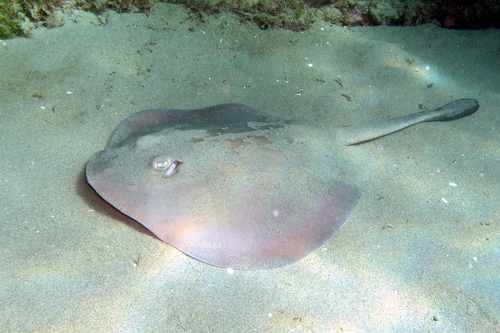
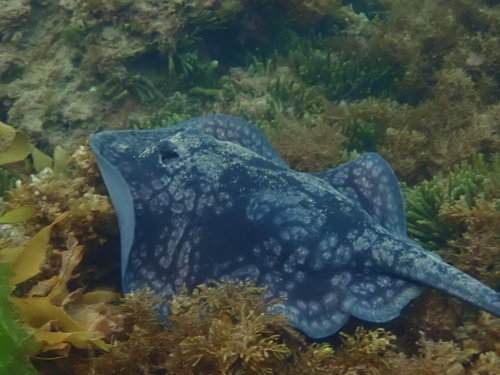
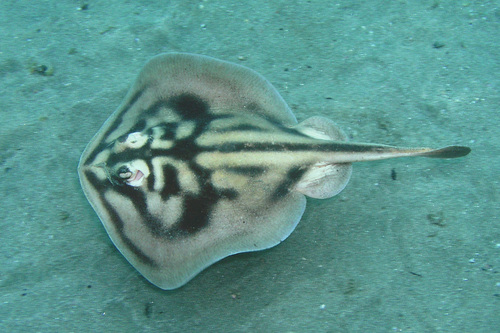
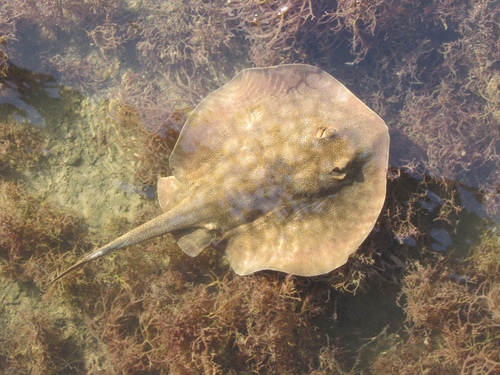
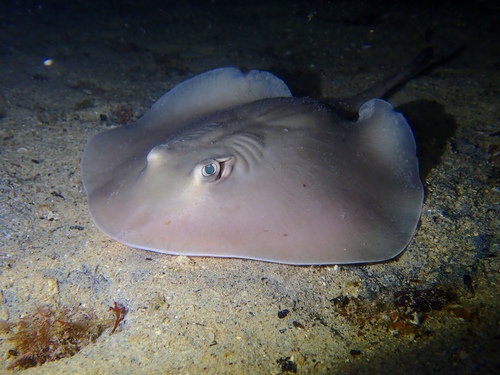
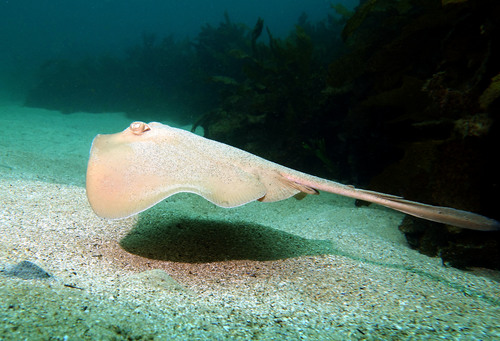
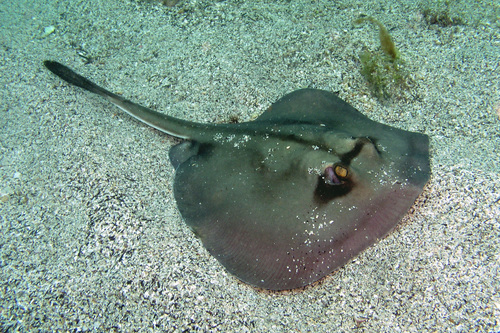
The pectoral fin disc of the Kapala stingaree (Urolophus kapalensis) is roughly diamond-shaped, with rounded outer corners and posterior margins, and is slightly wider than it is long. The leading edges of the disc are nearly straight, and meet at an obtuse angle at the fleshy, barely protruding snout. Its eyes are moderately sized, and are followed by teardrop-shaped spiracles that have rounded posterior rims. A subtle knob sits on the rear margin of each nostril. Between the nostrils is a bell-shaped curtain of skin. The posterior margin of this curtain is shallowly fringed, and its corners are elongated into lobes; only the sparsely-spotted stingaree (U. paucimaculatus) has a nasal curtain of this same shape. The mouth is small, and holds 5–7 nipple-like papillae arranged in a W-shape on the mouth floor. The lower jaw also has a patch of distinct papillae, arranged into a series of transverse ridges. Its teeth have rhomboid bases, arranged in a quincunx pattern; side teeth have blunt crowns, while teeth closer to the middle of the jaw have higher, more pointed crowns. There are 25 upper tooth rows and 31–32 lower tooth rows. The five pairs of gill slits are S-shaped. The pelvic fins are small with rounded rear margins; males have short, stout claspers. The slender, flattened tail is 82–90% as long as the disc, and ends in a low, leaf-shaped caudal fin; a prominent skin fold runs along each side of the tail. A very thin, serrated stinging spine sits on top of the tail about halfway along its length, and a long, low dorsal fin sits immediately in front of the spine. The skin has no dermal denticles at all. The Kapala stingaree is greenish on its upper surface, turning pinkish toward the disc margins, and has a variable pattern of dark markings that usually include a triangular blotch under each eye, a V-shaped bar between the eyes, a blotch at the base of the pelvic fins, and a pair of blotches in the middle of the disc that extend into stripes running onto the tail. Not all individuals have every one of these markings, and a small number may be mottled or almost entirely black on top. The underside is off-white with a wide, dusky band around the disc margin. The tail is pale with a dark midline stripe on its upper side, and sometimes has scattered dark blotches on its underside; the dorsal fin is greenish, the caudal fin is light with a dark edge in adults, and is entirely dark in juveniles. The largest known specimen of this species reaches 51 cm (20 in) in total length. The Kapala stingaree’s range is restricted to the eastern coast of Australia, found between Cape Moreton in Queensland and Disaster Bay in New South Wales. This benthic inshore species occurs between depths of 10 and 130 m (33 and 427 ft). Off Queensland, it is common in water deeper than 62 m (203 ft). Off New South Wales, it is rare north of the Clarence River, and common south of the river in water shallower than 50 m (160 ft). The Kapala stingaree prefers rocky reefs, adjacent sandy flats, and seagrass beds. The Kapala stingaree feeds mainly on benthic shrimp, mostly palaemonids, and amphipods, mostly ampeliscids; together these two groups make up around 70% of its diet by volume. Important secondary prey items include penaeid prawns and small bony fishes, while crabs, polychaete worms, and isopods are rarely eaten. Dietary composition stays mostly consistent across all age groups, though older rays eat a proportionally larger amount of amphipods and a smaller amount of shrimp than younger rays. Like other stingrays, this species is aplacental viviparous; developing embryos are sustained by histotroph, also called "uterine milk", produced by the mother. Litters typically contain only a single pup, which is born at around 15 cm (5.9 in) long. Males reach sexual maturity at around 28–31 cm (11–12 in) long.