About Urolophus halleri Cooper, 1863
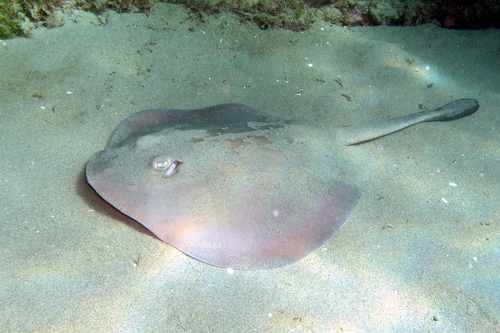
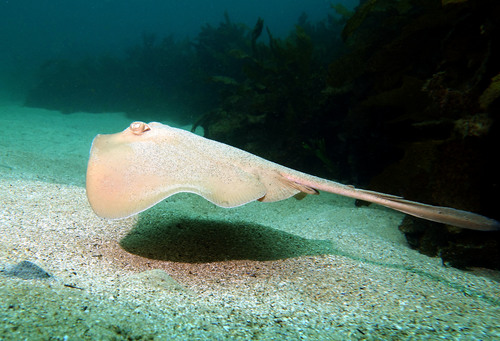
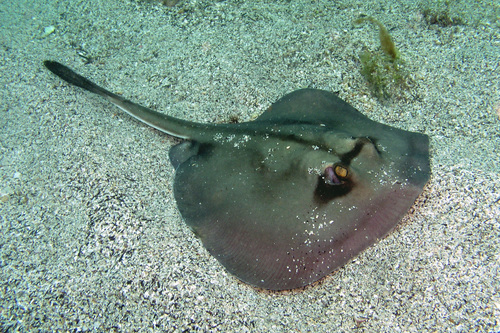
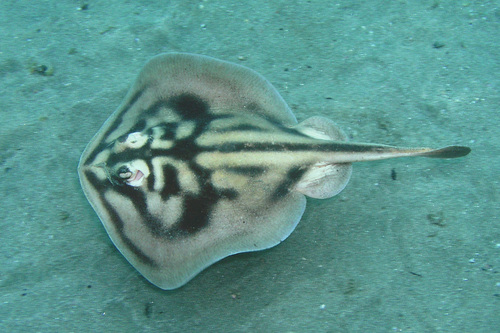
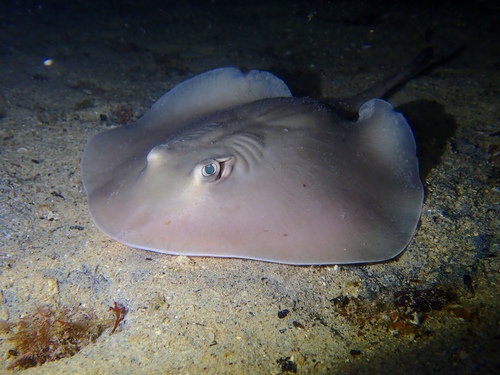
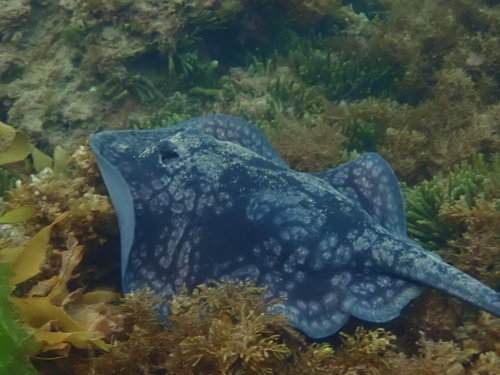
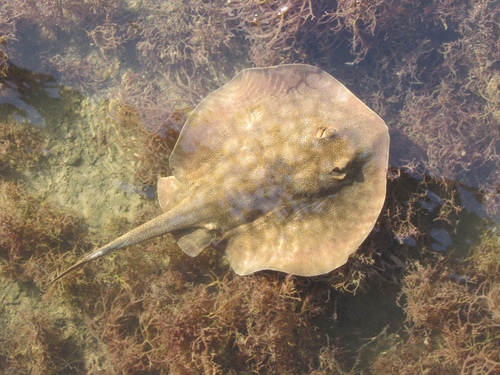
This species, commonly known as the round stingray, has the scientific name Urolophus halleri Cooper, 1863. The round stingray has an almost circular pectoral fin disc. Its upper surface is typically brown or grayish brown, marked with pale yellow spots or a reticulated pattern; some individuals are solid-colored or entirely black, while its underside ranges from white to yellowish. Its tail is short and stout, and bears a long, thick, serrated stinging spine. Its teeth are small and diamond-shaped, and show sexual dimorphism: the central teeth of mature males are erect, sharply pointed, and curved inward. Males reach a maximum pectoral fin disc width of 25 cm, while females reach a maximum width of 31 cm. The tail spine is regularly shed and replaced. For most of the year, round stingrays only have one spine, but small secondary spines start to appear in early July. The share of individuals with secondary spines rises to a peak around September and October, then declines as primary spines fall off and are replaced; the full replacement process is finished by December. This round stingray species is endemic to the eastern North Pacific Ocean, ranging from Humboldt Bay in northern California south to Panama, and is most abundant around southern California and the Baja Peninsula. It lives in tropical to warm-temperate nearshore waters, usually found at depths less than 15 m, though it has been recorded at depths of at least 91 m. It prefers soft-bottomed habitats such as mud or sand, which often hold abundant eelgrass that the ray uses for camouflage, but it can also be found near rocky reefs. Round stingrays favor water temperatures above 10 °C (50 °F), and adult individuals tolerate temperature changes better than juveniles. They are most numerous in the coastal and bay waters of southern California from spring through fall. In winter, they move to deeper water, where temperatures are more stable. Round stingrays have been observed gathering near warm seawater effluent released by coastal electric generators, which may mimic the conditions of estuary environments. In their natural habitat, round stingrays strongly segregate by age and sex: females stay in water deeper than 14 m, while males and juveniles occupy shallower habitat. Juvenile round stingrays feed on polychaete worms and small benthic crabs until their disc reaches 14 cm across. As they mature, their diet shifts to focus on bivalve molluscs. Round stingrays forage during the daytime, and are most active in the warm temperatures of summer and fall. They use their pectoral disc and mouths to dig large pits to uncover buried prey. This digging behavior plays an important ecological role, as it also uncovers prey for smaller fish. In the northern part of the species' range, round stingrays are hunted by northern elephant seals and giant sea bass; other predators include large sharks. Forty species of parasites from around 19 families are known to infect the round stingray. External parasites include copepods and leeches, while 16 species of tapeworms have been documented from its digestive system, including Phyllobothrium hallericola n. sp. and Acanthobothrium olseni. Additional parasites that may be found in this ray's spiral valve intestine include Eimeria chollaensis sp. nov. and Rhinebothrium spp. Like other stingrays, the round stingray reproduces via aplacental viviparity. Females produce litters of 1 to 6 young, with an average litter size of 2 to 3; litter size increases as female body size increases. Gestation lasts three months, and newborn young have a disc width of 6 to 8 cm. Females are capable of storing sperm year-round. In southern California, females move inshore to mate between April and June, and give birth to young between June and October. Further south in the Gulf of California, females mate and give birth earlier, from late winter to spring. A portion of the population mates and gives birth in winter, allowing for a second breeding season later in the same year. After giving birth, adult females return to deeper water, while young round stingrays remain in shallow water. Female round stingrays produce a localized positive electric field from near the spiracles behind each eye, to attract males. Males bite at this area, and successful contact is required for copulation. Round stingrays grow 3 cm per year until they reach maturity at around 31 months of age, after which their growth rate slows.